
Decolonisation V - Can Australia Ever Be A Middle Power?
Or, Why Australia chooses to live in the lies of an American world
This weekly ‘short’ post grew in the writing into a bonus Long Read. My excuse: the laments for Poor Fellow, My Country. Please enjoy and support my work with a subscription.
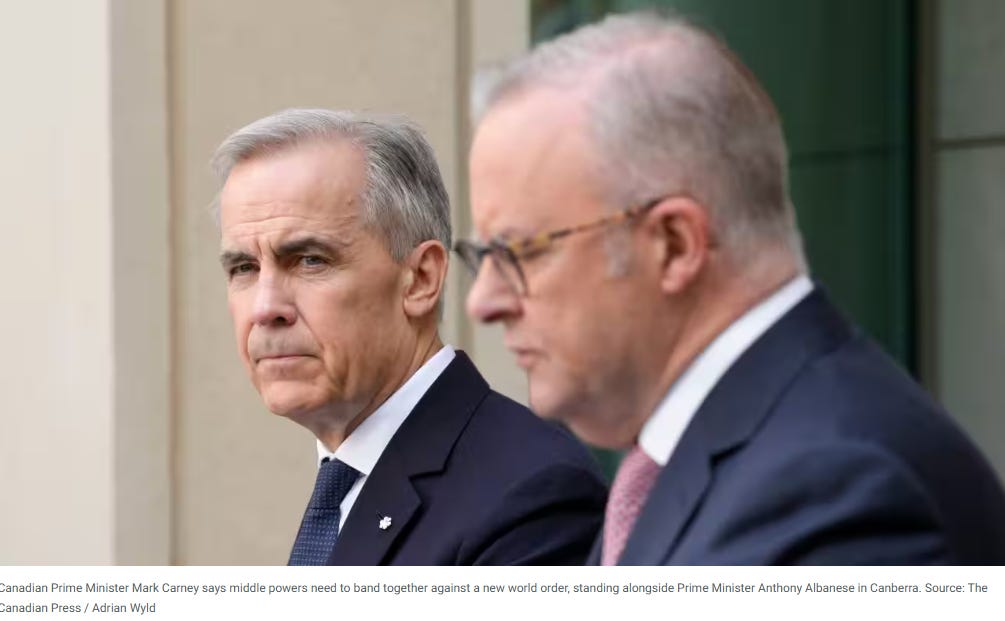
Australia feinted on the global stage this week when Canadian Prime Minister Mark Carney went to Canberra. Offered dignity as a middle power, the Australian Government acted the pawn in another USA-run war.
Disappointing, but what I have come to expect, and we have to deal with the world as it is, right? Or, so the realist fictions say. But let me tell you a stranger history of the plural Australian experience, and how this decolonised nation came to be that way.
Contemporary Australia’s muddled national sovereignty is the product of three botched decolonisation projects:
Federation as White Dominion, 1890-1920;
USA Agent in a British Commonwealth, 1930-50;
Deputy Sheriff and Starlet in the USA’s Liberal Empire, 1968-1999.
You may not have heard these labels; I devised them for this essay. But don’t worry: I explain the history and evidence behind them at the end of this post on Australia’s experience of decolonisation.
Mark Carney’s Wake-Up Call to Independence
In each of the three botched decolonisation projects, Australians - both élites and masses - chose belonging to an empire, which claimed global supremacy, over modest, gregarious co-existence as a middle power of one earth.
Now, in 2026, another historic opportunity for decolonisation has arisen. It was announced to the Australian Parliament by the Prime Minister of another decolonised dominion, Mark Carney of Canada.
“Yes, the world will always be driven by great powers, but it can also be shaped by middle powers that trust each other and act with speed and purpose.
Mark Carney, Address to Parliament, Hansard, 5 March 2026
Will Australia seize the moment? Will we act with speed and purpose? Will Australia ride, or get dumped by, a fourth wave of US American decolonisation, by the unravelling of the USA Empire?
My hunch is: we will get dumped, and then sucked out with the rip into the most dangerous waters. Like a bad cocky swimmer in rough surf, we have not been paying attention to the world “as it is” around us, and not even swimming between the flags.
At least, the mainstream élites in politics, business and culture in Australia have not been paying attention. The omens of this opportunity for a new decolonisation have been noticed in the Great Southern Land, for a decade or more, by a few dissident, reviled voices. Like antipodean Havels, we have tried to live in the truth, and point out the lies and slogans our leaders ask us to hang in our shop windows, like the indispensable American Alliance, our great and powerful democratic friend, and the ‘liberal rules-based international order,’ exposed as a sham by Mr Carney at Davos. But Australian leaders have suppressed all readings of the omens. They have blocked their ears and masked their eyes. They refuse to see Australia as anything but the Deputy Sheriff of the USA’s Empire or some B-grade celebrity starlet aspiring to be enriched by Rupert Murdoch’s global media empire.
The Closing of the Australian Mind
The Australian mind is closed and colonised, like few around the world. It may be because Mr Murdoch has so successfully counter-colonised the political and cultural networks of imperial masters, Britain and the USA. It may be because we botched our past three attempts at decolonisation, and the gulfs have washed us down. It may be that we have been unlucky in our leaders. But I suspect, most deeply, it is because, in each attempt at independence, we neglected one crucial truth: colonisation begins and ends in the mind.
Few of our intelligentsia see the opportunity for decolonisation that so many other countries have seen around the world with multipolarity, the redistribution of power, and the redirection of the currents of global exchange of people, resources and ideas. Even this week the admirable Korean-US American commentator, KJ Noh, saw this opportunity amid the disasters unfolding around the world.
This right now is an opportunity for a real decolonization that never fully happened. We have to understand that the modern world that we inhabit was never decolonized. It was only partially decolonized. Essentially the former colonial powers handed off their colonial control to successor colonial powers who created a regime of neo-colonial control largely through financial means and also through control of the oceans and the choke points and through a comprador élite. All of these things were built into the new system. But right now what we have is an opportunity for a real decolonization.
KJ Noh Is This the End of US Hegemony in West Asia? | KJ Noh on Iran War Escalation, 5 March 2026 (28:46 to 29:30)
But we don’t see that opportunity here in Australia. We are lost in space, floating in a tin can, high above the Indo-Pacific.
But when an old friend flies from Canada to Canberra and sits down with you for a heart-to-heart, you would think those Australian élites would listen. In fairness, some did. Mr Carney acknowledged former and friend, Prime Minister Malcolm Turnbull, and former Reserve Bank Governor Glenn Stevens in the audience of his 4 March Lowy Institute speech. But the overall climate of opinion, in the lead-up to Carney’s speech, has been to push back and to reassure the USA that we will not threaten its pre-eminence; to reinforce the impression that we are the USA’s most loyal and dumb dog. For a week or so, the Murdoch press has been poisoning the well, and promoting fairy tales about the British inheritance and our special relationship with the USA. Michael Fullilove of the Lowy Institute, the lugubrious host of Lowy’s Austral-American club, served up the same approach in his questions of the visiting Prime Minister. Each question ignored the questions on the world’s mind, and displayed a 2020s Australian version of a 1970s Czech shop-window sign, ‘Workers of the World Unite.’
It is a pity. It leads me to conclude sadly that Australia will botch this chance at a more mature relationship with the whole world.
It is not that Carney - and Alexander Stubb of Finland at the Indian Raisina Dialogue - did not set out well-reasoned proposal for a new model of multilateral diplomacy as a middle power on one Earth. In Canberra, Carney laid out some cold, hard facts of the post-war world, and the changed world to come, with the elegance, depth and precision of a two-times central banker. In New Delhi, Alexander Stubb, made an even more remarkable statement in the context of talk of the onset of World War Three:
The foundations of the United Nations were built in San Francisco, much like the framework for our global financial system was built in Bretton Woods. I think what the world needs now is a new San Francisco moment. A moment where world leaders come together in the spirit of cooperation to think long and hard how to reform the international institutions that have served us since World War II. We need to rebalance the world order. We need to agree on the principles on which we can find common solutions to common problems. And if I may, my procedural proposal is that we should have a New Delhi moment. In other words, that India gathers world leaders here in Delhi and begins the process of looking at what happens after wars.
Alexander Stubb, Raisina Dialogue 2026 (Transcript 24:28 - 25:21)
Perhaps, President Stubb has been reading the Burning Archive, since I have been writing about a Peace of Delhi like the Peace of Westphalia since 2023.
But the Australian leadership ignore me, and Messrs Carney, Stubb and Modi. In his appearances with Mr Carney, Prime Minister Albanese guffawed something about “we can back ourselves” - out of the corner of a Bunker, do you mean, Albo? But it was new Australian Opposition Leader, Angus Taylor, who best articulated the hive mind of the Australian élite. Taylor has been in the job for less than a month, after a couple of leadership spills. But he is already virtue-signalling towards the USA’s new MAGA clique. He has dispensed with the dog-whistle to shout anti-migrant, nationalist signals out loud. He declared his loyalty to the new USA civilizational empire, with rhetorical skill, if little logic, and a small taunt of Mark Carney.
The rules-based international order has been exposed as wishful thinking of a bygone and benign era, especially in these times when autocratic regimes act with impunity [Note to readers: Just to clarify any confusion, he does not mean the USA]. I wholeheartedly agree with you; in this brave new world, middle powers cannot simply build higher walls and retreat behind them. We must work together. We must act together, closer than ever, on defence, on secure supply chains and sovereign capabilities, on maintaining free trade. As you said, the strength of our values matter and the value of our strength matters. It’s that moral clarity that must guide us and protect our way of life.
Angus Taylor, Speech before Canadian Prime Minster’s Address, 5 March 2026
Taylor made clear the resolve of the colonised Australian mind, as expressed by its securitocracy and the Murdoch media. In a nervous anticipation of Carney’s address, he set out a red line. Australia will not co-exist with all the peoples and civilizations of the earth. It will only settle for being a “middle power of the West” [my emphasis]. All pretence of sovereignty was neutered by submission to the USA’s new Western Reconquista, declared again by Rubio at Munich 2026.
Middle Power: Three Strikes & You’re Out
Carney invited Australia to be a middle power in this changed world. It looks like he will be rebuffed. His offer was based more on hope than history. Carney should have checked Australia’s batting record on decolonisation. If he had, he would have realised that he had asked a country to step up to the plate of the middle powers which has already swung three times at independence, and declared itself, well and truly, out.
Three times we sought more status within a global empire, threatened by the processes of decolonisation. Three times we stood with the Empire, and turned our back on the decolonising world.
Why would it be different this time? Especially since this fourth attempt will be the hardest. If Australia were to get on board with Carney’s ‘variable geometry’ and India’s multi-vector diplomacy, it would have to escape the Iron Bunker that the USA has screwed into the world since 1945. As I discussed with Nel Bonilla this week, the NATO elites are tightening those screws and battening down the hatches as they fear demotion and sense the entropic forces destroying their power.
I hope, against history, that we can free ourselves from the Bunker and its permanent screening of the American Dream of World Domination.
I imagine, with history, that the USA empire could embrace its defeat, free little Australia from its claws, and renounce supremacist beliefs that drive its crusades and and Reconquista. I discussed that imagining of the USA embracing defeat like Imperial Japan after 1945 with Pascal Lottaz this week.
But I suffer the slings and arrows of history, when I read the news and historical record of what Australian leaders do every time they have a chance to stand with the Global Majority against the Mighty Empire.
Within hours of Mr Carney’s invitation to be a middle power within a multilateral UN system bound together with all in international law, and on the eve of Mr Stubb’s process proposal to convene a Peace Conference of New Delhi for a post-US-colonial world, what does Australia do? We send military planes to join the USA’s war in Iran, to bombard more citizens, and to destroy another society. We sign up to another illegal, immoral imperial war.
Poor fellow, my country.
In this dismay, however, history can also console. Since history can be retold and remade many ways. It can be written by survivors, not just victors. So I regain my composure by telling variant histories of this decolonised nation and the recolonised peoples of this Great Southern Land, Australia.
Here are two versions: one, figurative and poetic; one, more scholarly and analytical.
Australian Decolonisation: A Prose Poem
My doctorate research was on the social history of colonial Australia. As the adjective implies, I live in a post-colonial state that was both a “settler-colonial” society and itself a colonising state. ‘Australia’ was named Australia del Espíritu Santo by the Portuguese navigator, in the service of Spain, Pedro Fernandes de Queirós. He set out from Europe via the Caribbean and Peru in search for the Great Southern Land that quixotic explorers imagined might be a New New World of riches.
He was unaware this island continent was the most arid on earth, and had already been occupied for tens of thousands of years under different names by ‘nomad colonists’ who travelled probably from the Philippines and Sulawesi, via the area that is now New Guinea. On arrival, they moved around and lived, as much at war as at peace, as any other society, until the Europeans came in dribs and drabs and then one big rush after the American Revolution, but before the French.
Settler colonialism came to Australia in 1788 in the form of a British military and penal colony. The colonists of New South Wales, together with their masters in the Colonial Office in London, formed, over the next 110 years, new colonies on the East, South, West and North of Terra Australis, and even in 1840, New Zealand. There they met the Māori, a branch of the Polynesian societies, the truly great maritime navigators and colonists of the Pacific, who would call their colonised islands, Aotearoa.
Over that 110 years, there was much strife: frontier wars and urbanisation; civil unrest and wild colonial boys. The New Australians followed the USA model of dispossessing the native nations that were not nation states. Migration from Europe, Asia, the Americas and even a little from Africa replaced the custodians of the land and denied their claims to title and an ancient culture. Shameful massacres and democratic innovation, exploitation and cultural expression, nationalism and imperialism, barbarism and civilization vied for the historian’s attention. Sheep and mines took over the land. Cities towered at widely distant points on the coasts; while, in the mysterious inland, no sea was found, just the Bush. Clippers, then steam ships and submarine communications cables connected the remote colonies to the mother country, or to use the Greek word, (μητρόπολις (mētropolis), composed of μήτηρ (mētēr, “mother”) and πόλις (pólis, “city” or “town” or, let’s say, country).
In the last fifty years of the colonial era, the aristocratic and commercial rulers of that metropolis in Britain slowly released their grip over their New Europes. In 1901, the Australian colonies “decolonised” via federation; they took the status of one Dominion, named a Commonwealth, celebrated their unique nation-continent, and proved their loyalty to the British Empire by dying like dogs in trenches during World War One. At the Versailles Peace Conference in 1919, this new post-colonial nation celebrated the principle of national self-determination by breaking up rivals to the British empire, while seizing one former German colony for its own; Papua New Guinea would become an Australian colony or ‘territory’ until 1975.
Over the course of the twentieth century, more real independence came to this ‘decolonised’ ‘nation’. It took control of foreign policy in the 1930s, pivoted to the USA Empire after the collapse of Britain’s South East Asian Empire in 1942, allied with the West and fought communist decolonisation during the Cold War, broke trade vows with the mother country when Britain had an affair with the European economic community from the 1960s. During the 1970s, a surge of cultural, political and economic nationalism in Australia coincided with decolonisation’s peak decade. Portugal’s empire ended in Africa and in East Timor, our near neighbour, in 1975.
But disappointment and, some say, the CIA, struck. Independent Indonesia took martial control over decolonised East Timor, and would not release it from its bloody South-East Asian colonialism until 1999, when Britain left Hong Kong and Portugal gave back Macau. When the Whitlam Government shouted sovereignty from every rooftop, it spooked our new Cold War masters, the Yanks. In three short years, the Whitlam Government made trips to Red China, granted independence to Papua New Guinea, denounced South African apartheid, tried to nationalise resources, subsidised Australian stories for Australian screens, and even threatened to evict the Americans from Pine Gap. The undeclared empire struck back. The murky debates about the dismissal of the Whitlam Government in 1975 will continue for decades. It seems certain, however, the USA security state wanted a regime change; it is less clear they needed to execute a coup to get it. The local elites did it for themselves.
In any case, from the mid-seventies, Australia’s long 75-years process of decolonisation was aborted or went into reverse. We were now the American empire’s most loyal attendant. Our starlets all moved to Hollywood. In 1990, Nicole Kidman even married Top Gun Tom Cruise. After the Cold War and the internet, talk of ‘Australian national identity’ disappeared largely. We all had so many better shows to watch. For a while, they came from the world. Before long, the USA’s Western monoculture recolonised Australia, at least in the domains of media, culture, politics, business, and, above all, security.
And a year after the 1975 Dismissal, our own dynastic media oligarch and local princeling, Rupert Murdoch moved to the USA. There he built a new transnational media empire that would colonise the minds of the English-speaking world through Fox and Sky News, The Times and the New York Post. Murdoch’s endorsed political spin, tabloids and business interests became the broadcast messages that blared from loud-speakers erected in every room of the Australian NATO Bunker.
This historical fable of the strange defeats of decolonisation in Australia has a point. The history of colonisation and decolonisation is not a fairy tale of goodies and baddies, of national independence and falling empires. The places, cultures and narratives of colonisation, and its undoing, interweave in a tangled braid. I am not sure the story ever ends.
Australian Decolonisation in Global History
In Martin Thomas, End of Empires and A World Remade: A Global History of Decolonisation, there is not a single index entry for Australia. This oversight is understandable since Australia is but a small thread of this tangled history. Its story is minor compared to the tragic, blood-stained struggles for national independence in Africa, Asia and the Americas. Even so, Thomas’ core argument applies to the Australian experience: decolonisation was the “biggest reconfiguration of world politics ever seen,” and, after at least a century, this process is still remaking the world.
By rethinking what decolonisation is, Thomas shows it changed societies in ways more profound than the traditional narrow legal concept of decolonisation: the sequence of high-level reforms that led to a definitive constitutional transfer of power and membership of the UN, to be celebrated ever after as the day of national independence. Rather, Thomas wrote:
“Decolonization fostered bold experiments in social, racial and gender equality. It changed prevailing ideas about sovereignty, citizenship, and collective and individual rights. Its contestations stimulated new types of social activism, innovative forms of international cooperation between governments, and a global surge in transnational networking between nonstate actors, activist groups, and those that colonialism otherwise excluded. Some of the ideas involved were locally specific, but many more were shared, borrowed, or adapted among the peoples caught up in fights for basic rights, for self-determination, for the dignity of cultural recognition.”
Thomas, End of Empires p. 7
These dimensions of decolonisation are familiar themes of Australian history, but are usually seen with the limited vision imposed by the blinkers of nationalist historiography. For example, a long established theme of Australian historiography is that, in the era of its first decolonisation, the federation era of 1890-1920, Australia was a social laboratory of the world. Free of the social hierarchies of the ‘old world,’ young Australia’s population of ‘transplanted Britons’ conducted “bold experiments in social, racial and gender equality.”
Through Manning Clark and generations of later historians, the decolonisation story has been refracted as an unresolved struggle between the conservative imperial forces of Anglo-Australia and the progressive forces of true post-colonial national identity. In recent decades that radical nationalist story has included the indigenous peoples as First Nations Australians. Both Paul Keating and Malcolm Turnbull enshrined this story in their attempts to establish Australia as a republic in the 1990s, breaking with the last attachments to the British imperial monarchy and asserting Australia could only assume its role in Asia by leaving behind its colonial heritage. Mark McKenna adumbrated the theme (you can also check my interview with Mark here) in discussing Australia’s muddled foreign policy:
“Although Australia sees itself as a middle power exercising its own influence in the Indo-Pacific - a mentality strengthened by the Keating government’s pivot to Asia - its deepest and most valued alliances remain true to its British colonial origins.”
McKenna, The Shortest History of Australia, p. 258
Decolonisation is discussed in this broad historiographical church, but usually through the impact of white settler colonialism on the indigenous peoples and the set of discriminatory attitudes and exclusionary policies of White Australia - the White Australia Policy. I discussed this shameful past last year in my piece on migration as part of the India World History tour.
Those issues are central to the Australian story, but my emerging interpretation reframes them with two perspectives: the broader, longer global history of decolonisation, and a deeper analysis of Australia’s ‘British colonial origins.’ If Thomas neglected Australia in his history of decolonisation, most Australian historians neglect the experience of decolonisation in how they tell the story of the Australian nation, people and continent, from before 1788 to 2026.
Australia and the British World System
The great historian of the British empire and decolonisation, John Darwin, made neither mistake. In The Empire Project: The Rise and Fall of the British World-System 1830-1970, he showed that Australia played a major role in that British world-system that functioned like a messy, shape-shifting project.
I will discuss this book later in the year, but, in brief, Darwin dismantles with history the international relations fantasy that in the nineteenth and early twentieth centuries Britain was the ‘world hegemon.’ Rather, British imperial elites pursued an “empire project” that functioned as a complex system in which there were many independent agents. Like the USA empire today, the British had deep insecurities about the exposure of their liberal rules-based order to internal instability and external threat.
Part of that threat, at the time of Australian Federation, were the forces of early decolonisation and the fissiparousness of the world. Indeed, Darwin’s description of how Britain’s elites saw the world during the empire’s period of ‘hegemony’ has an uncanny resemblance to Nel Bonilla’s description of the NATO elites’ fear of loss of power in the Bunker State surrounded by the entropy of the Void. They saw threats everywhere.
“Its [British Empire’s] external borders were easily permeable, and open to influences from America, Europe and Russia (after 1917), and from the intellectual heartlands of the Islamic world, and even from China and Japan (whose revolt against the West was much admired by Gandhi). Internally, too, ‘British’ culture coexisted uneasily with indigenous cultures and those of non-British settlers. By the late nineteenth century, it faced strong cultural movements in India, forms of cultural nationalism in French Canada, Ireland and among the Cape Afrikaners, and was feebly equipped to attempt a cultural ‘mission’ among its new African subjects. The angry assertiveness of some British cultural ‘messengers’ and their periodic fits of despondency reflected not their calm superiority (as is sometimes assumed) but a mood often closer to a siege mentality.”
Darwin, The Empire Project, p. 6
I did a video last year on these Dark Visions of Empire in a shrinking world, including reference to the Australian Charles Pearson and his impact on none other than Teddy Roosevelt.
Can you hear the echoes from the Bunker? And did you notice that Australian nationalism was the least of Britain’s imperial problems?
From Dominion to Partner, but Never a Vassal
Darwin identified four major components of the British world system:
the imperial core of the ‘United Kingdom,’ including its oldest colonies of Scotland and Ireland;
‘Greater India’, the “‘sub-empire’ ruled from Calcutta (and Simla), extending from Aden to Burma, and with its own sphere of influence in the Persian Gulf, Southwest Iran, Afghanistan and (for some of the time) Tibet,” coastal East Africa, governed from Bombay, and the Straits Settlements of the Malayan Peninsula;
the commercial republic of the City of London and the vast trans-continental network of investments facilitated by steam globalisation and submarine communications cables; and, crucially for this discussion,
the ‘awkward squad’ of self-governing settlement colonies, called ‘dominions’ after 1907, or, colloquially, ‘the white dominions’,” including Australia.
These colonies promoted to dominions were never vassals, an over-used word and misunderstood concept. The Oxbridge intellectuals and Foreign and Colonial Office diplomats might talk at the club and the office about the leaders of this ‘awkward squad’ in such insulting terms. They “found them prickly and unyielding, and took their revenge in disparaging minutes.” In the same way, the US American intelligentsia display their irritation at the insubordination of Europe and other ‘vassals’ on a thousand podcasts today. But, Darwin wrote:
“In fact, the dominions were a critical element in British world power. The remarkable loyalty of the ‘overseas British’ and their economic efficiency made them the most reliable overseas part of the whole British world-system.”
Darwin, The Empire Project, p. 11
Without understanding this key point, you cannot understand the dynamics of the unravelling British empire, the botched decolonisation processes of Australia, or the strategic culture of the Australian foreign policy élite, right up until today.
“Dominion politicians declared over and over again that Canada, Australia, New Zealand and Newfoundland were ‘British countries’, or ‘British nations.’ To them and their constituents (since this was a popular not an élite point of view), the ‘Empire’ was not an alien overlord, but a joint enterprise in which they were, or claimed to be, partners.”
Darwin, The Empire Project, p. 11.
The same sentiment was expressed this week by Australian élites made uncomfortable by Mark Carney’s call to pursue multi-vector middle power diplomacy, even with non-Western nations.
If Australian elites were not vassals, neither were they rebels, or leaders of ‘anticolonial uprisings’, as Rubio said. They did not face the hard choices of the Third World who had to cut out a path of violent resistance, and cultural redefinition of identity, due to Western empires clinging to dominance in most Asian and African countries in the twentieth century. Australia took the insiders’ route to decolonisation. Even after the much mythologised moment of 1942, after British defeat at Singapore, when Australian wartime Prime Minister John Curtin turned to the USA, free of the pangs of old attachments, Australia pursued the pooled sovereignty and security within the primary empire, not outright breaking of colonial shackles. Australia never tried to escape the predecessors of the Bunker. It sought an appointment as an honour guard, or Deputy Sheriff, or Capo, to keep the disorder of a changing world under control.
Indeed, in the years from 1942, after Japan humiliated Britain at Singapore and during Gandhi’s Quit India campaign, Australian Prime Minister John Curtin pursued a proposal for a strengthened Fourth British Empire in which the White Dominions would play a more prestigious and influential role. Curtin pursued his idea to rejuvenate empire through the promotion of the dominions with the Canadian Prime Minister of the time. Churchill rejected him, since he was imperialist to the core, and Britain pursued parity with the USA in the post-1945 world. Australia’s long, drawn-out defection from the British to the USA Empire took another forty years.
Australia was a set of colonies, then a dominion, then a hinge between post-1945 USA and Britain, until the British World System whimpered out in its winter of discontent in the 1970s. It bridled for a short period in the 1970s when the USA rode it hard. But ever since, Australian politicians have perceived the USA not as an overlord, but a difficult partner. Through all these phases, Australia adapted institutions and ideas about sovereignty, international cooperation, and multilateral networking. It attempted decolonisation, but dared not say that name. It called it an ‘independent foreign policy’ and learned to live in a lie while acting in the interests of an undeclared empire. It assumed the role of the USA’s deputy-sheriff in the Indo-Pacific. Its security bureaucrats and transnational elites énjoyed the gig and the status rewards. But they overlooked the fact that the USA hands out that badge, like beads and baubles, to the little people it does not respect.
Australia’s Three Botched Decolonisation Projects
In my February Long Read, I sketched a history of six waves of decolonisation in modern global history:
Decolonisation before Nation States to 1825
Decolonising Dominions and Self-Governing Territories 1825 to 1914
Decolonising Rivals in Eurasia 1917 to 1945
Decolonising Western European Empires 1945 to 1985
Decolonising the Soviet Empire 1985 to 2000
Decolonising the Western American Empire, our present and future.
I will develop this sketch further in my Long Read in March. But let me close this piece, by fitting Australia’s story of decolonisation into these six waves.
Federation as White Dominion, 1890-1920
The first wave of decolonisation, before nation states, is not entirely irrelevant to Australia. The decolonisation of some British North American colonies in 1776 gave impetus to the British colonisation of Australia. The humiliation of losing one colony, and watching Spain and France lose more, shaped approaches to the penal settlement and colonial government in the distant Australian experiment in the South Pacific. From the beginning, Australia’s experience of colonisation and decolonisation was shaped by an imperial commitment to keep the Australian Britons loyal.
However, the major first wave of decolonisation in Australia came with Federation and the early development of the Commonwealth of Australia as a ‘White Dominion’ of the British Empire between 1890 and 1920.
The Australian case was one of many such imperial fragments that became self-governing territories or ‘new nations,” from 1825 to 1914. It happened in Britain’s imperial core with the debate on Irish Home Rule. It happened in Europe with the Italian and Hungarians regions of the Austrian Empire and the increased autonomy for Poland and other regions within the Russian Empire.
John Darwin placed Australian Federation in this broader global context. It was not the Birth of a Sentimental Nation, as argued by John Hirst, inspired by big ideas of cultural independence. It was not, Darwin argues, “the imagining of a distinctively Australian nation that had shrugged off its colonial status.” Rather, this process of decolonisation was a defensive response to global shocks:
global economic shocks in the 1880s and 1890s,
deepening racial anxiety fuelled by migrant labour from South and East Asia and the Pacific (and common across the world),
internal social conflict, including the legendary maritime strike of 1890 which led to the Australian Labor Party forming as one of the early successful, but highly pragmatic, social democratic parties of the world, and
fears of Asian rivals to the British empire.
The last point is fundamental, and coincides with the expansion of the Japanese Empire in the 1890s. Darwin wrote that Federation occurred against a rupture uncannily similar to events today:
“In the mid-1890s, as great power competition in China accelerated, a new factor catalysed Australian anxiety. Japan’s victory over China in 1895, its annexation of Taiwan and the rise of Japanese migration in the Pacific region signalled the emergence of an Asian great power and brought home the true extent of Australian vulnerability in the new fluid era of world politics.”
Darwin, The Empire Project, p. 164
Australia’s first pulse of decolonisation sprang from fear and clung to empire. It made Australia the “confident vanguard” of Britain’s world system. Fittingly, this phase ended with Australia becoming a coloniser too. After the 1919 Peace of Versailles, Australia took over German colonies in the Pacific, including Papua New Guinea. This phase also poured the mould for élite Australian strategic thinking ever since. As Darwin wrote,
Before 1914, and long after, to Australian opinion of almost any hue, independence outside the imperial framework would have meant not the fulfilment of Australian nationality, but its certain negation. Their nationalism was the fuel, just as federation was the vehicle, for finding Australia’s true place in the system of empire.
Darwin, The Empire Project, p. 168
Reluctant USA Ally in a British Commonwealth, 1930-50
The same pattern occurred in the next phase of decolonisation that occurred in the context of the global imperial war of 1931 to 1945. In this period, the Australian Government assumed more control over its foreign policy amidst rolling international military and economic crises.
There were tensions between Australia and the metropolis over hard power. Arguments broke out over how much of the British naval fleet would protect Australia, especially after the start of war in 1931 between Japan and China, which also threatened British and Australian neo-colonial interests in East Asia, such as the treaty ports of Shanghai and Hong Kong. There was a furore over aristocratic misconduct during the ‘Bodyline’ cricket series in 1932. But, most importantly, there were conflicts precipitated by the Great Depression from 1929, which in turn led the British Empire to pursue an ‘imperial preference’ policy of protective tariffs, to extract resources from the empire in preparation for war against its challengers, and to turn the screws on Australian government debts, in part incurred during World War One.
This crisis led to a radical populist state Premier, Jack Lang, winning an election in New South Wales with a policy to ‘nationalise credit’. His radicalism provoked secret armies, talk of coups, and preparations for civil violence, and imperial interventions. Lang twice defaulted on his state’s overseas debt, which led to his dismissal in 1932. But this brief local crisis had a long tail. It created a strand of radical nationalist resentment at the ‘Anglo-Australians’ who had rallied behind the bankers and the Brits. Later Prime Minister Paul Keating was mentored by the dismissed Jack Lang. As a youth and young politician, Keating visited Lang’s home frequently. He sat at his feet and was schooled by him in a rare strain of anti-colonial Australian thinking. He absorbed the sentiments of Lang much more than he ever read the histories of Manning Clark. Those visits created a living heritage of radical nationalism. It forged a political and historical mythology of Labor’s recalcitrance to empire and its pursuit of a truly ‘independent foreign policy’ with anticolonial characteristics. Historians, like Clark and Don Watson gave voice to those sentiments. As Darwin wrote,
“Some historians have been tempted to see in the crisis a conflict between conservative middle-class loyalists, deferential to Britain and earnestly mimicking British upper-class rituals, and Labour’s ‘radical nationalist’, bent on resisting Britain’s imperial demands’.
Darwin, The Empire Project, p. 452.
The myth still holds, and was restated in Prime Minister Albanese’s speech on ‘progressive patriotism’ and an independent foreign policy that I discussed in Progressive patriotism fails the independence test. Especially since the 1970s, the myth has obscured the real meaning of Australia’s pivot to the USA, in the depth of the strategic abyss of the British Empire in 1942. In reality, Curtin and both his Labor and Liberal successors pursued a policy of making Australia a strong pillar of the Fourth British Empire, as I discussed in this video.
Australia emerged from World War Two tempted by American affluence, grateful for the US Navy, but still deeply loyal to the British Empire. While Nehru led the Non-Aligned Movement and Aimé Césaire wrote The Discourse on Colonialism, Australia’s leaders botched their chance at decolonisation. They became instead a USA double-agent in the British Commonwealth. Robert Menzies sought to join NATO while taking ‘forelock tugging’ to comic theatrical extremes with his adulation of the monarchy and imperial honours. But post-war Labor Leader, and Curtin’s successor as Prime Minister, Ben Chifley did not break the mould that had been set at the turn of the century, of Australia being a sub-imperial power of an assumed hegemon. “Australia today,” Chifley said, while the post-1945 world took shape, anticolonial uprisings broke out, and Churchill brought the Iron Curtain down over Europe, “has become the great bastion of the British-speaking race south of the Equator. Strategically and economically this country has assumed a position in the Pacific on behalf of the British Commonwealth.”
Deputy-Sheriff and Starlet in the USA’s Liberal Empire, 1968-199 9
The third pulse of Australia’s botched decolonisation emerged in the ruins of Britain’s world system. By 1970 decolonisation had taken off and Britain’s last major colonies were gone, even though it clings to a few military colonies still. Economically, Britain pivoted to Europe, in bad faith. It broke its last promises of trade loyalties to Australia during the late 1960s and joined the predecessor of the European Union in the early 1970s.
In the context of the deep social changes of the 1960s - liquid modernity, 1968 and all that - Australia experienced a cruel spring of cultural nationalism and a brief surge of political independence. Whitlam went to China. Australian films were made. Patrick White won the Nobel Prize. Germaine Greer led the feminist world. Everyone wore flowers in their hair, and a few brave, if reckless, souls dared to protest against the American military bases in Australia. They pricked the tightening grip of the USA’s global security state empire. And the empire kicked hard against the pricks.
The renaissance of national independence reached its height during the Whitlam Government (1972-75) and was strangled in the crib. For a few months there was talk of kicking the Yanks out of the vast global surveillance base at Pine Gap in Central Australia. But the dismissal of the Whitlam Government in 1975 snuffed out the last hope of any structural sovereign autonomy in Australia. The American Alliance replaced the British Empire as the cornerstone of Australian strategic religion.
I will not detail the history of Australian foreign policy since. But since 1975, Australia’s dependence on the USA has grown in pulses of increasing intensity:
after 1982, with the Hawke Government’s election and its implementation of American neo-liberalism
after 1989, with the end of the Cold War and Australia’s embrace of China’s economic growth in the hope it would become Chimerica
after 2001, when Australia invoked the ANZUS alliance because of the attack on the Twin Towers in New York and locked itself into wars in West Asia, and
since 2011, with President Obama’s “Pivot to Asia”, announced in an address to the Australian Parliament before a fawning Prime Minister Gillard, which quickly spiralled out of control into China Red Scare and the return of the 1890s dark visions and fears of a growing Asian empire.
But this was not only a political phenomenon. The Deputy-Sheriff had a partner in the form of a cultural Starlet, ever so keen on fame and fortune on American stage and screen. As I wrote in Patrick White, Nobel Prize and Australia’s aborted cultural decolonisation, in the post-1945 period there was a genuine process of cultural decolonisation in Australia, which was symbolically crowned by Patrick White’s Nobel Prize in Literature in 1973. This process was very different to that experienced in Africa and Asia, but still a detachment from imperial influence. As the British Empire crumbled, and the complexion of Australian society changed, several generations of Australians created cultural institutions and social networks that exchanged ideas more freely in ways imagined by, and in idioms spoken by Australians. Not His Master’s Voice.
Australians told Australian stories, and they began to sell. The meaning of an Australian story became more universal, embracing and many-coloured. Australians won prizes, and became famous on the international stage and screen. The rebel culture of Russel Ward’s Australian Legend overturned Menzies’ misty British Empire, but retained its pose as the voice of the outsider. Ned Kelly was reimagined, over and over again, in film, television, fiction, museums, tourism, and history.
This process brought the outsiders to power, and showered them with money. This new creative nation sold its soul to become the cultural industries. They became all-American starlets like Nicole Kidman and Hugh Jackman. The rebirth of a nation was smothered by American consumer culture, which after 1991 proclaimed itself the universal solution of history.
The progressive cultural nationalists, the neoliberal economic reformers, and the security officials who built quietly a Bunker set the Australian nation on another course. They botched the last chance of nationalist decolonisation before the age of the internet. They challenged a tired old elite, attached to the old country, but then generated a new cohort of tired old elites committed to an empire of lies. They had broken with Britain, but embraced America and its fantasy of the universal progressive empire that dare not say its name. The Austral-Americans were born, and became the enforcers of today’s sterile regime culture. The Young Tree Green had spawned the Old Dead Tree.
Meanwhile outside the world of the elites, ordinary Australians all got used to reading syndicated articles from the Washington Post as well as the Murdoch press, to watching Bridgerton on Netflix rather than BBC costume dramas, and to consuming the American digital world through tech platforms whose algorithms scrubbed the last memory of national identity.
We became comfortably numb in the US American virtual reality bubble in the basement of the NATO Bunker.
We - elites and public - botched our third attempt at decolonisation.
A Coda of Pessimism and Hope
Will the global conflict that is spinning out of control in West Asia shake Australia from its stupor?
As we say in Australia, as a trace of our complex colonial experience, I reckon we have Buckley’s and none.
But too much pessimism helps no one. We could follow another course. We could choose peaceful coexistence over violent empire. We could remake ourselves in this new Crisis of the World, and take up the opportunities of a messy tangled world, identified by people as different as Mark Carney, Alexander Stubb, Nel Bonilla, Ulrike Guérot, KJ Noh, and even this very very minor former government official.
Maybe, but it will not be because of our political leaders. It will not be because of our cultural élites. It might, however, be because a few readers of the Burning Archive realise that decolonisation begins and ends in the mind.
Thanks for reading and here’s hoping for peace on earth.
❤️🙏🌎
Jeff
We can only do what we can do. As you said, the US will bite back hard if we don't follow. It has, and it will again. Business will not like it, and will not allow it, and we are not prepared, as a nation, and as any other nation, to go against large vested interests. So we need to choose, and its the devil you know. It naive to pretend that we could stand on our own feet. Not possible. Same lesson applies to Europe, as to any other country. Except those that are in a position to choose Russia, or China. Economic alliances? They don't work, let's face it. Resistance? Not possible without an army, or, subtle hint, without our own nuclear weapons, something that I don't believe any Australian politicians has ever seriously contemplated, not that they would be allowed to.
I await the "pivot to China"