
How the New Antisemitism Spiralled Out of Control
And along the way formed a new American-Jewish identity
The “New Antisemitism” has become normalised, says Jillian Segal, Australia’s Antisemitism Envoy. But she has her history wrong. Let us make sense of the real history of antisemitism and how it led to Israel and the USA spiralling out of control.
In this week’s post, the stories of antisemitism, decolonisation, Western empires and socio-cultural change come together in the post-1945 world story of how Israel, the USA, and American Jewry formed a very special relationship and a new cultural identity. But this new partnership spiralled from the Holocaust to Gaza, leading its champions to accuse critics of Israeli state violence of being antisemites.
It was the Six-Day War that was perhaps the real turning point, immeasurably boosting Israel’s image in the United States and thereby transforming the relationship between Israel and American Jewry. . . . As the commentator Henry Feingold noted, “The American Jewish identity, which Zionists predicted was destined to fade . . . was actually strengthened by the establishment of the Jewish state.”
Mazower, On Antisemitism, p. 137
Reminder. Monthly Book Club Live Call
Paid subscribers can join me for a live call to discuss Mark Mazower, On Antisemitism, and all my posts this month, on 31 May at 10 am Melbourne time (+10 UTC). Details of the Zoom call link will be shared next week.
The three chapters of Mazower, On Antisemitism I have read through this week show the social, cultural and international history through which the complex phenomenon some call “the Israel Lobby” formed not as a “foreign lobby” but a product of USA history. These three chapters are:
Chapter 5: Aftermath: Cold War Europe (from Part 1: Europe in the Age of the Antisemites)
Chapter 6: Prelude: The United States, Israel and the Middle East 1940s-1960s (from Part 2: On the Battlefield of Ideas)
Chapter 7: A New Antisemitism? The International Arena
Remarkably, all the themes I am writing about this year (decolonisation, social fragmentation, cultural identity, and shifting world order) play a part in the story told in these three chapters. That story culminates in the formation of joint US American and Israeli cultural label of a “New Antisemitism.” It is no longer the old antisemitism of the Catholic Church, the European Right or the North American Nativists. It is the ideological animus chanted by the Left, critics of Israel state policies, and opponents of USA imperialism.
It is the “New Antisemitism” publicised through the Australian Royal Commission on Antisemitism.
Australia’s Antisemitism Envoy Defines the New Wave of New Antisemitism
“So when we look at antisemitism today, as I see it, Islamist extremism on one side, including those inspired by or acting in sympathy with organisations like the Muslim Brotherhood. We have far-right, neo-Nazi or white supremacist antisemitism, and they use the Nazi tropes and imagery. I think we have far-left or issue nominated, issue motivated activist groups who almost as articles of faith consider Zionism as a justification for attacks on the Jewish community. And they all use old-fashioned tropes as well. So it’s a bit confusing, because they’re using tropes from history, but they are reusing them in these three forms of antisemitism.
But then I think we have a fourth form, and this is the form that I’ve been very focused on in my plan, and that is those who just conflate dissatisfaction with the legitimacy of the State of Israel or the actions of the government of the State of Israel with the Jewish people and, particularly, we are focused on Jewish Australians and for that conflation itself to be expressed as antisemitism.
It’s the fourth one, that conflation, that I think is the growing one and is the one that has helped antisemitism or pushed antisemitism from the margins to being normalised, to the centre. And it’s a mask of really blaming the Jews, but they really focused on what the Israeli policy has been or the way it has carried out the war in Gaza, et cetera. But they use the ancient tropes as well, so they are bringing some of that old-fashioned antisemitism.”
Jillian Segal, Australian Antisemitism Envoy, Testimony to Royal Commission on Antisemitism, 7 May 2026
The problem is that this “New Antisemitism” is no longer new, and long ago detached from “ancient tropes”. It is rather an old denunciation that Mazower dates precisely. In 1974 former Jewish American advocates published a polemic that sought to redefine “traditional notions of antisemitism.” Its title? The New Anti-Semitism.
A new orthodoxy—that antisemitism was the same as opposition to Israel, and that it was therefore chiefly a problem of the Left rather than the Right—was being laid down. Thirty years later it would come to seem unassailable common sense to a lot of people, but at this time it was a novel argument. Presaging the neoconservative drift to the Right of some prominent American Jewish figures and organizations in the 1980s and 1990s, The New Anti-Semitism cited the radical Left’s sins: its criticism of American support for Israel, its cheerleading for Moscow and the Communist movement, its exploitation of post-Vietnam American war-weariness.
Mazower, On Antisemitism, pp. 168-169
This change of meaning of our word in history was decisive and potent in its reshaping of remembrance.
As a way of explaining hostility to Israel in terms that connected it to the Jewish past rather than its geopolitical role in the present, the invocation of antisemitism in this context marked a new stage in the history of the concept. Antisemitism did not by any means lose its historical associations with the old animosities shown to a historic minority people; on the contrary, its power as critique derived from those memories and echoes of the past [my emphasis].
Mazower, On Antisemitism, pp. 165-166
But the power of this antisemitic turn did not derive from money or the ‘Lobby’ or ‘foreign influence’ or Mossad special operations. The turn was driven by the USA American response to decolonisation and “deeper shifts in cultural and intellectual thought in both the United States and Israel.”
This is the story of how USA and Israel together spiralled from the Holocaust to Gaza. This essay builds on my April commentary, Vassals, Lobbies, Proxies or Dominions?Interpreting the role of Israel and other allies in the the USA’s World System, on Nel Bonilla’s essay, The Imperial Feedback Loop: Beyond the “Lobby vs. Proxy” Debate: How Neoconservatism Fused US Hegemony with Israeli Strategic Culture.
Before we get to that main story let me share some footnotes and tangents.
Decolonisation, Antisemitism and the Palestine Question
“It was not so much the European war as the colonial system that preceded it and threatened to outlast it that made the position of the indigenous Jewish minorities in the Arab lands precarious. The rise of pan-Islamism as an anti-colonial movement fueled a discourse ill-prepared to draw a distinction between Zionists and Jews—a distinction that in any case it was improbable the illiterate strata of the population would be likely to make.”
Mazower, p. 149
During the week I shared a Note on Mazower’s chapter 5 “Aftermath: Cold War Europe,” which follows these twists and turns in Western and in Eastern Europe and the Soviet Union. It focussed on the forgotten proposal in the years 1943 to 1948 to establish a new Jewish homeland, not in Palestine, but in Crimea.
I also reflected on how the USA and US American Jewry’s impassioned engagement with Israel is about much more than money, blackmail, imperialism, geopolitics or the absurd slop served up by ‘Professor Jiang’. It arose from the social, cultural and emotional history of the USA itself.
Let me repeat the key insight of that Note that Mazower gleaned from a late 1960s pamphlet by sociologist, Marshall Sklare.
Sklare argued that Israel’s creation and existence had restored what he called ‘a sense of meaning’ for American Jews after the Second World War. . . . it could seem that “something new, clean and good was born” out of the genocide. Thus were Israel to be annihilated, the final victory would—in some metaphysical sense—belong to Hitler, and American Jewry would be faced with a “complete loss of meaning” and “total anomie.” Sklare’s analysis suggested that it was because the destruction of Israel would threaten the psychic existence of American Jewry itself that people felt so strongly that the country had to be supported.
Mazower, On Antisemitism, p. 139
Mazower’s book also discusses the historical realities of ‘Arab antisemitism’ and how that adapted to events, and most especially the nakba, or catastrophe, of the ethnic cleansing of the Palestinians and Arabs by the new Israeli state in 1948. The nakba, he comments, was both an early failure of decolonisation, instigated by some of the same imperial failures that caused the horrors of Partition in South Asia in 1947. But it was also a culminating event in a series of post-Second World War refugee crises that had occurred across large parts of Europe and Asia.
Remarkably, he quotes the private conversation of Israel’s founder and first Prime Minister, David Ben-Gurion with a diplomat and head of the World Jewish Congress in the early 1950s. Responding to a suggestion that the nationalist Arab states would want to negotiate peace with Israel, Ben-Gurion said,
“Why should the Arabs make peace? If I was an Arab leader I would never make terms with Israel. That is natural: we have taken their country. Sure God promised it to us, but what does that matter to them? Our God is not theirs. We come from Israel, but two thousand years ago, and what is that to them. There has been antisemitism, the Nazis, Hitler, Auschwitz, but was that their fault? They only see one thing: we have come here and stolen their country.”
—David Ben-Gurion
His public rhetoric was different; but today in Australia, in some European states and the USA, this private conversation may well lead the first Prime Minister of Israel to being charged with being an antisemite.
Finally, Mazower’s history shows a curious connection between Israel and the USA’s pursuit of antisemitism, and their long-standing resentment towards those ‘godless communist’ ‘anti-colonial uprisings’ (Marco Rubio) after 1945 and the interference of the United Nations. Remember Mark Mazower has written a history of the UN and global governance, Governing the World: The History of an Idea (2012).
After an ‘international swastika outbreak’ in 1959-60, Israel and the USA put a resolution to the UN condemning “manifestations of antisemitism and other religious and so-called racial prejudices.” Yes, “so-called racial prejudices” was the text drafted by the USA diplomats, as the civil rights movement raged and Nina Simone sang Mississippi Goddamn. But the resolution did not read the room.
“With decolonisation in Africa and Asia, the UN was becoming a genuinely global organization where the tensions and debates around the epic struggle over the fate of peoples under European colonial rule were played out before the world’s media. . . . To the newcomers, European concerns and its recent history mattered less than they did to the UN’s original members, and empire, colonialism, and race mattered more.”
Mazower, p. 161
The antisemitism resolution did not pass, but the watershed 1960 decolonisation resolution did. Israel and the USA began to nurse a grudge, especially when newly liberated Algeria began to campaign for the rights of the Palestinians. The grudge got worse after the 1967 Six Day War, the worldwide campaigning for the rights of Palestinians whose land Ben-Gurion admitted he had stolen. The UN passed the “two-state solution” resolution. But it was a 1975 resolution on racism that set afire Israeli and USA’s resentment against the UN. That resolution equated Zionism with racism and Israeli, USA-sponsored policies with apartheid in Africa. It was a form of colonialism and neo-colonialism and a racist regime.
Combined with the West’s growing resentment at the rebellion of the Global South, expressed in the reaction of neoliberal and neoconservative policies, the USA and Israel determined to “go into opposition” at the UN (the phrase was that of Daniel Patrick Moynihan, US ambassador to the UN). Mazower summarises from his history of the UN and antisemitism:
Washington now not only saw its interests increasingly aligned with Israel’s, but also moved to sideline the UN—which it had once dominated—by operating over the next two decades on the assumption that it was basically a lost cause. For their part, Israeli diplomats saw the UN as an institution hopelessly weighted against their nation.”
Mazower, p. 165
The USA’s long diplomatic death spiral had begun: all the way to the disgrace of Trump’s rants at the General Assembly in 2025 and the ignominy of the Trump Gaza Peace Board. Israel was involved; but the USA was to blame.
How Israel and the USA Spiralled from the Holocaust to Gaza.
[I shared the starting point of this reflection in a Note on Friday.]
Historians know what memory politics forgets.
No grave historical trauma, not even the Holocaust, lives on through lived experience alone. Remembrance changes how past pain is remembered. Narrative weaves metaphor into the expression of hatred, even antisemitism.
Don’t get me wrong. The Holocaust was very real. I have been reflecting on it for fifty years. Even if its memory is invoked for political purposes, anger at what Israel does today does not relieve us of the moral responsibility to challenge the “bafflement and demoralisation” of thinking about the unthinkable. This is what Inga Clendinnen called the Gorgon effect:
“the sickening of imagination and curiosity and the draining of the will which afflicts so many of us when we try to look squarely at the persons and processes implicated in the Holocaust.”
Clendinnen, Reading the Holocaust
Or indeed, the incomparable unthinkables of the 1948 nakba, the Bengal famine, the Conquest of the Americas, transatlantic slavery, the Trail of Tears, China’s Cultural Revolution, the Khmelnitsky massacres of the 1640s in Poland/Ukraine, the USA ‘fighting Russia to the last Ukrainian‘, the genocide in Gaza . . . .
The list sadly is too long for one human heart to bear.
There are so many horrors in history. It is always a time of monsters. Our ways of perceiving those monsters, of calming and inciting ourselves in the gaze of the Gorgon, change with the winds of history, especially the mercurial history of culture.
In the 1970s, Mark Mazower shows in On Antisemitism, a constellation of sacral remembrance of the Holocaust did not emerge from the Lobby or Mossad, but also not without intentional advocacy by the US American Jewish community. It emerged from deep currents of US American cultural, social and political history.
Until the mid-1970s, the Shoah was largely mourned more privately. When the USA Holocaust Memorial Museum was established in the mid-1970s, historian Lucy Dawidowicz (The War Against the Jews, 1975) protested that this form of commemoration was “not an appropriate means to remember the Dead of the Shoah.” Israeli historian, Evyatar Friesel, who fled Germany in 1939, and lost most of his family in the Shoah, went further.
“There was something deeply wrong. . . in the way American Jewry was trying to depict the destruction of European Jewry. Those museums . . . were contrary to the Jewish tradition of mourning and remembering: they would be little more than an hour of contrived sorrow, of gimmickry and make-believe. Worse . . .these plans indicated not sorrow for the destruction of European Jewry, but some darker and disruptive dimension in the soul of American Jewry itself.
Evyatar Friesel, The Days and the Seasons: Memoirs (1996)
But from the mid-1970s in museums, films, history, fiction, political ceremonies and the grief of reinterpreted lived experience, the remembrance of the Holocaust became a symbol of the US American soul itself. It became for the average US American, in a culture with a reputation for historical ignorance, one of the ‘best-known events’ of world history.
Ironically so, perhaps. And with distortions of remembering. Mazower comments on the irony of the New World’s remembrance of the grave crimes perpetrated in the Old World. “By 2011,” he remarked, memory of the Holocaust “rivalled the US civil rights movement as a historical reference point for civic education in the country of chattel slavery and the American Civil War.”
I wonder whether, indeed, the Holocaust has become for US American culture a screen memory to convince its citizens, troubled by their conscience, that they have been a force for good in the world; not among global history’s darkest souls. Earlier this year, I wrote how the film Nuremberg, which included a long segment depicting the images of survivors of the death camps as displayed at the trial, exaggerated the centrality of the Holocaust to the Nuremberg trial. Decades of Hollywood films have now created a myth that the USA fought the Second World War to save Europe and the World from the German Question of Antisemitism; and has equally forgotten the victims of the Soviet Union, the three wartime Chinas, and of obliterated Hiroshima, Nagasaki and fire-bombed Tokyo. It erased from memory the war aims and crimes of the British and USA empires. It condemned Asian and African ‘collaborators’ with Germany and Japan who had sought to throw off the Western colonial yoke. It obscured the post-war integration of former fascists into powerful roles within the post-1945 Western alliance’s political, military, security and cultural institutions; not mere ‘collaborators’ but many useful officials, ideologues and participants in the ‘unthinkable crimes’ of the Axis powers. Shamefully, in 2023, the Canadian Parliament stood to applaud and to honour one of those war criminals of the Holocaust, Jaroslav Hunka (see my post, The Moral Darkness of Standing with Ukraine).
But let us return to the story line of Mark Mazower’s book. The new remembrance of the Holocaust got caught in a riptide of history that changed the meaning of that word, antisemitism.
The US American Jewish community embraced public memorialisation in place of private mourning. The USA, public and state, embraced Israel with the deep identification that is now familiar.
“American Jewish organizations, which had once resisted the calls for memorialization, now insisted on it; Israeli governments, which had once been loath to discuss the past, now pressed for it. And the Holocaust itself, a genocide perpetrated by Europeans upon other Europeans, had somehow become a guarantee of America’s commitment to Israel. . . . Most striking of all perhaps for the historian of antisemitism and its shifting meanings, was how the memory of the Holocaust came to be combined with attachment to Israel across the increasingly diverse and secularized world of American Jewry as a marker of ethnic identity.”
Mazower, p. 182
This idea of ‘ethnic identity’ in the USA very much came into its own in the 1970s too, in part in reaction to the civil rights movement and in tension with the claims of Black Americans.
In my essay, Vassals, Lobbies, Proxies or Dominions? Interpreting the role of Israel and other allies in the the USA’s World System, I built on Nel Bonilla’s idea of a transmission belt of social-political amplification or an imperial feedback loop. I suggested there was a spiral of resentful radicalisation. I commented that:
Nel reframes the two competing theses and explains the role of the Israel lobby/proxy as a form of amplified influence, manufacturing consensus in response to the social pressures of diaspora and religious networks. This analysis is a great advance on the Israel lobby argument that presents the Lobby as somehow external to USA society and political culture. The ‘Israel Lobby’ - or the military colony of Israel in the alternative argument - is not extraneous to US American social history. It is a product of that history.
In addition, I foreshadowed that Mark Mazower would shed light on how these diasporic formations and home-grown ethnic identities (Jewish-Americans, Italian-Americans and so on) metamorphose through culture and become what they are through unique paths through history. It is this chapter 7, “A New Antisemitism? The International Arena,” that - perhaps surprisingly given the title - sheds light on both domestic and international sources of a new US American-Jewish cultural identity that underlies the concern with the new antisemitism we still witness today.
That identity, shaped by the American society, to which large-scale Jewish migration had occurred since the 1880s, had changed profoundly one century later.
“By the 1980s American Jewry was a porous and diverse world in which more than four out of ten adults were married to a non-Jew and regular synagogue attendance was declining. Many commentators worried that this meant the end of Jewish life in the United States.”
Mazower, p. 184
This prosperous, Americanised community, whose culture is familiar to any consumer of the USA globally exported cultural industries, had no intention of emigrating to Israel, as the post-1945 Zionist and Israeli leaders hoped and lobbied for. But their social conditions could have readily lead to the dissipation of their American Jewish identity in the consumerism and “shows about nothing” of this American life. Life was good in New York, and, despite the Cassandras, a new stronger sense of ethnic identity emerged. They were proud to belong to the new identity that crystallised, argues Mazower, around two poles.
The first pole was identification with Israel. Sociologist Nathan Glazer described this idea as “the Jewish religion for American Jews,” and the faith was deepened by practices such as travel and citizenship, and intensified by convictions with consequences, such as that the land of Israel had been given by God to the Jewish people.
The second pole returns us to our reflections on remembrance and cultural politics. The Holocaust became the second pillar of American Jewish identity. “Thus,” Mazower wrote,
the Jewish state and the Jewish catastrophe had between them become for many American Jews the intertwined core of a new identity. The Holocaust was commonly understood to rationalize the existence of Israel, which in turn seemed to enhance the security and status of American Jewry.
Mazower, pp. 184-185
The enigmas of social and cultural “identity” have been themes on the Burning Archive since 2015. Just what do we identify with in our identities? How much difference can one identity tolerate? How can any “identity politics” negotiate differences with the strangers and outsiders who do not share this identity? I prefer to wear my identities lightly. After all, I am multitudes, not identities. But identities can become prisons, both for those who profess them and those who dare to question the core beliefs that sacralize them.
Identities, like life stories, are perhaps best understood rather than argued with, and certainly not mocked; but identity politics creates most often a spiral of resentment, bickering, and intensified militancy. Mazower shows how the curious feedback loops through which a Jewish American form of identity politics took shape through mutual influence and antagonism, in particular between the civil rights movement, the old and new civic religions of the American Jewish community and its supporters, Black Antisemitism and Jewish racism, the long fight against institutionalised racism, and the rival claims to historical and present-day victimhood of the African-American and Jewish-American communities. In addition, in the case of the American Jewish community there was an international dimension, the state of Israel. Any suggestion of “dual loyalty”, however, such as in the Israel Lobby arguments, only provoked a more “militant public self-assertiveness,” and determination to make their core political issues the mainstream concerns of American political life and to make themselves indispensable political insiders. The ‘Israel lobby’ became a metonym for the American republic. Where exactly do the boundaries of ethnic and national identity lie in a mixed, multicultural democracy?
There was, moreover, another feedback loop, driven by cultural and intellectual history in Israel, and the global diaspora. The ideas of Israel and Zionism are not fixed in a “settler colonial doctrine.” They have changed over time. As the cultural shifts occurred in the USA, Mark Mazower writes, “inclining more and more American Jews to see attacks on Israel as threats to their own ethnic identity, a parallel anxiety about antisemitism was also emerging in Israel.” (p. 187) The spiral of resentment intertwined with a spiral of anxiety.
That anxiety fixated on an historical myth intensified by remembrance of the Holocaust: that the Jews were, as stated in the Bible, “a people that dwells alone.” This myth spiralled with another: that antisemitism was a unique, endless, and ineradicable antipathy, more enduring and more serious than any other. Antisemitism was the Longest Hatred.
This article of faith was vindicated by the Israeli nationalist historians of the Jerusalem School, including Benjamin Netanyahu’s father. This version of history has been retold at the Australian Royal Commission by the witnesses of lived experience and community advocacy, even the Antisemitism Envoy, Ms Segal herself. Mark Mazower makes clear that such an interpretation of history seems to most historians:
“poorly argued, bizarre, even ahistorical: What kind of historian believes in any force moving unchanged through time in the way these historians portrayed antisemitism? The real story is different, and in many cases not expressive of hatred at all.”
Mazower, On Antisemitism
But “a people that dwells alone” requires a myth of being surrounded by hate and religious zeal to endure its fate. As a result, Israeli culture increasingly turned its back on the early Israeli vision of a secular Jew, and adopted an increasingly zealous religious vision of nationalism suited to a people defiant and alone. Remembrance of the Holocaust reinforced this new vision of Israel, and resonated with the new civic religion of Jewish America, identifying with Israel, belonging to the memory of the Holocaust. But so did demography. The Orthodox population grew. The non-Ashkenazi population grew. ,
From the 1970s, another strand of social history was woven into Israeli and the USA’s civic consciousness. The emigration of Soviet Jewry, accelerating after 1990, led to nearly 2 million Soviet Jews leaving the USSR and successor states between 1970 and 2018. Israel became home for 1.3 million of these emigrants, and many others came to the West, including Australia. Some gave testimony to the Antisemitism Royal Commission, claiming that “communism was worse than the Nazis.” A Cold War crusading ideology, in which the good USA played saviour to the world’s Jews and freed Jerusalem as the capital of the Jewish homeland once again, was added to the spirals of resentment and anxiety.
In 1996 these spirals may have petered out as Prime Minister Yitzhak Rabin sought to dampen down Holocaust analogies to Israel’s circle of eternal enemies, make peace in the Middle East, and return to the early Israeli visions of Israel as “a normal nation.” It was a very 1990s dream; Boris Yeltsin aspired to the same for Russia. But Rabin was assassinated by a right-wing zealot and the abandonment of old secular Israel for new Jewish nationalism, led by Benjamin Netanyahu, became entrenched.
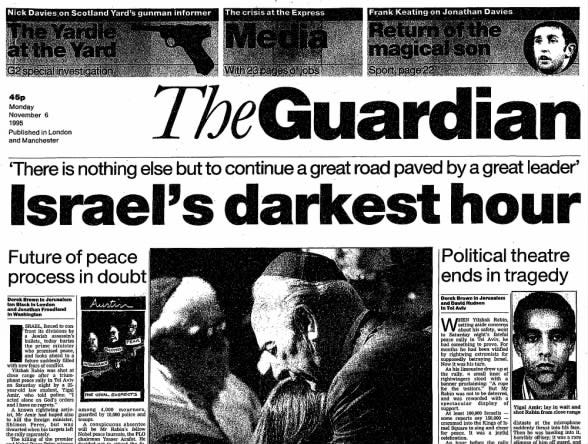
Israeli society hardened and embittered, and began the descent into the hell of Gaza. This turn can only be seen as a form of socially validated expression of hatred, to echo the IHRA definition of antisemitism. Mazower commented:
“the minority was becoming dominant and not merely dominant but increasingly domineering. As Israeli society became more overtly polarized, the presence of a racist Right—and of racist attitudes stretching beyond it—was tracked in social scientific surveys. Against Arabs, above all, prejudice was rampant.”
Mazower, p. 194
The prejudice and the racism shocked the older Israel, including refugees from 1930s Europe. But history had turned them into a forgiving minority; and social conditions in Israel—supported by an ascendant hegemon with a saviour complex, the USA—turned the majority into haters, and eventually killers.
“By the early twenty-first century, more than four fifths of Israelis had been born in Israel, where they had grown up with the occupation, discrimination against the Arab minority, and an increasingly empowered settler movement as facts of life.”
Mazower, p. 195
The rest, one might say, is Gaza.
Or ending civilization in Iran tonight.
Thanks for reading this long post. Do check my backlist and YouTube channel for more content on these themes, including my readings from Inga Clendinnen, Reading the Holocaust.
Jeff
When you talk about Jews crimes they start hiding behind this word "antisemitic" ... Israel committed a freaking genocide!!! Free Palestine and Rot in H Israel!
Netanyahu and supporters of the state of Israel keep trying to conflate Zionist Jews with all Jews - a political entity with a religious identity. The left and many Jews themselves largely distinguish Jews from Zionists.
At primary school age, friends were emerging from one Jewish school in east London and telling us they were superior as they were literally "chosen" for privilege by god. More progressive Jews, who didn't separate their kids from society, insist this meant "chosen" in the sense of having a benign responsibility for all humankind. So there you have one bifurcation in plain sight.