
Migration Panic at Ceuta, Civilizational Identities, and European Peasants' Wars
From 30 July 2026, migration panic spread from one of the Pillars of Hercules across four continents in response to 70,000 irregular border entries from Morocco to the Spanish African territorial enclave of Ceuta. Beneath the headlines, this incident contains some deeper strands of migration, decolonisation, and how contemporary fragmented societies construct cohesive political myths of belonging. There is even a link to my recent reflections on Marxism, through the German Peasants War of 1525 and my world history club book of the month, Summer of Fire and Blood.
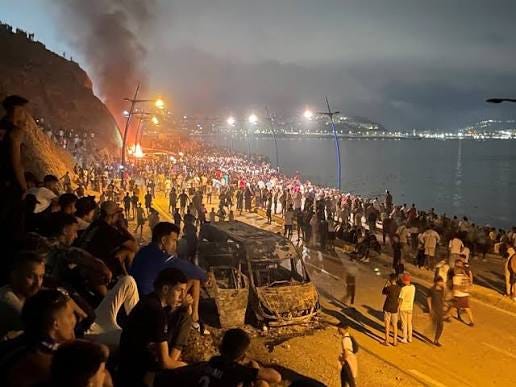
Migration Panic at Ceuta
The tragic loss of life at Ceuta was rapidly exploited for political purposes by groups in and out of Spain. Experts speculated that state and non-state actors may have weaponised migration, as indeed occurred in a previous incident at Ceuta in 2021. A few on the left blamed Israeli intelligence because of Spain’s position on Gaza. But the loudest voices were the Conservative Internationale: Spain’s Vox leader Santiago Abascal, Trump and Musk, Farage and the AfD, and, here in Australia “Stop the Boats” Tony Abbott and ascendant anti-migrant politician Pauline Hanson. Civilizational warrior for hire, Douglas Murray scowled that “Europe’s borderless dream had become a nightmare.” Right wing parrots in every pet shop screamed “mass migration,” the Christian West, “invasion” and civil war. None bothered to examine how the Spanish agencies managed to contain the incident within a few days.
This border incident then was no summer of fire and blood.
Spain is experiencing a summer of fire. Spain has suffered a season of fire in intense heat, causing dozens of deaths. The wildfires (or bushfires, as we say in wild colonial Australia) are not in Spain alone. The intense heat waves have ignited fires in France, Greece and Türkiye and led to claims that Europe has suffered the worst fire season in modern history.
But as yet this summer has spilled little blood, at least not the kind associated with civil war. The Spanish Government has confirmed 75 people died attempting to cross the water at Ceuta. More than 70,000 of 72,000 of the irregular migrants have returned to Morocco after the incident. Small protests have occurred in Ceuta reflecting conflicting views on the event and the impact of the surge on the city’s population of just 80,000. Within mainland Spain right wing parties exploited the fear of non-European migration amid the fire emergencies and ahead of a national election in 2027. But this is standard manipulative populist illiberal politics. It is no “invasion.” It is starting no “civil war.”
You would not sense that, however, if you listened to the illiberal right, sponsored by that megaphone of stupidity, the US American oligarch and parastate actor, Elon Musk. Musk chimed in with a stupid, tasteless post on his platform, comparing the incident to the World War Z zombie movie. It was “absolutely an invasion” and would destroy Spain’s entire budget. A few weeks before he conducted a bizarre interview with The Economist in which he implied that if current trends continue, there will be a “reckoning” in Britain. In 2023, he claimed “if current trends [meaning mass migration and replacement of white European culture with others] continue, civil war in Europe is inevitable.”
Musk’s interventions reminded Europe and the world that the USA had endorsed in its 2025 National Security Strategy the masked statement of the Great Replacement Theory that Europe would within a decade or so succumb to “civilizational erasure.”
The invasion, crisis talk was spread by the usual suspects across Europe. One wonders how many of these talking heads and streaming activists were boosted one way or another by USA State Department funding, the private munificence of Musk and other US American oligarchs, and the network groups such as Atlas or the Claremont gang (including lead author of the 2025 National Security Strategy, former Murdoch speechwriter, disciple of Leo Strauss, and chef, Michael Anton). It even spread to Australia, which is no stranger to migration panics. The arch-exploiter of that panic, former Prime Minister Tony Abbott repeated his mantra of at least ten years that Europe was facing a “peaceful invasion.”
Despite the panic merchants of the illiberal right, Spain and Europe have governed their way through the crisis, containing the problem, even if they may ultimately not win the politics. There was a brief wobble for a day or two when France, Denmark and Italy tightened border controls and scored points against the progressive thorn in their South, Pedro Sánchez. The doubts and minor actions taken by these states have, however, been dubbed gestures of “theatrical control” that make little difference to the actual work of policing the border, processing the refugees, and slowly resettling the migrants, even the irregular ones. Within the week, the European Commission had locked behind the Spanish and shared, flawed yet effective European response. Irregular migration to Europe has declined in recent years. The crisis talk is a political fable.
And questions were emerging about the role of social media disinformation, foreign intelligence agencies, and the US American oligarchy’s covert war in Europe on trade, technology, and social cohesion. Did the CIA or other state or non-state actors deliberately instigate the migration surge to undermine the Sánchez Government in negotiations? There are many candidate provocations - on issues of Gaza, Palantir, Sahrawa, or merely to support a preferred election outcome in Europe backing the Vox party, which echoes the USA National Security Strategy rhetoric on civilizational erasure and a new Reconquista. Morocco, Israel, and Algeria all have their own different motivations. Several of the theories were discussed in this interview by Pascal Lottaz of the Algerian political commentator Fethi.
I tend to think Fethi overplays the role of Israel in this crisis, however much they have sought to embarrass Spain in the media. Spain attributed the crisis to the actions of illegal criminal people-smuggling gangs. I find this explanation at least as plausible as other theories. Those operations are capable, ruthless and resourceful. They may well have sought to bust a hole in the Schengen border, with the hope of later exploiting it. I strongly suspect the USA intelligence agencies, and private oligarchs, were involved in exploiting the situation. Morocco also has several reasons, with no connection to Israel, to put pressure on Spain and Algeria, including the dispute over the Western Sahara with the indigenous Sahrawi people, who seek recognition of their self-determination as the Sahrawi Arab Democratic Republic. Spanish gestures of support for this state led to an earlier weaponised migration incident at Ceuta with similar characteristics of Morocco assisting the surge, if covertly. In a strange coincidence, the Moroccan King wrote to the USA President in July to announce that a major highway to the Western Sahara would be renamed “Donald J. Trump Highway.” But such letters of obsequious flattery arrive in Washington every day. The extent of orchestration of events will emerge over time. I suspect later analysis will show a mix of underlying conditions, pull and push factors, spontaneous reactions, some partly realised orchestration of events, and many cynical acts of exploitation of poor, vulnerable people.
Crucially, however, Spain, resolved the crisis in a few days and then offered a gracious way out for Morocco that avoided any feuding or shaming of any misbehaviour by the state that Spain depends upon to help control its borders. Spain is indeed central to migration politics in Europe. It receives the largest number of migrants from outside Europe, more than Germany and three times the number in France. The policy of regularisation of migrants who have lived in Spain for five years will continue, and is a decent thing to do as any Australian familiar with the problems of long term residents on temporary protection visas will know. Podcasters and pundits might huff and puff about amnesties and incentives; the ordinary reality of governing the situation, however, demands coming to terms with the need for social support and legal security for the migrant strangers who live among us.
Pedro Sánchez’s fragile progressive coalition Spanish Government appears then to have weathered the Ceuta storm. It may not remain that way after next year’s scheduled election, which may see conservative parties, including the far right Vox surge to a combined majority. But government is about more than electoral politics. Next year’s election, however, no doubt explains in part the migration panic across the right-wing media universe.
Whatever the fate of Sánchez’s election next year, migration panics will not go away, after this summer of fire and blood libels. That is for two reasons. Immigration and cultural or civilizational identity are core to the new Atlantic right politics and are difficult issues to contain. They are far too prone to the politics of “control signalling.” In Australia we have been having these debates for decades now, ever since the infamous Tampa incident of 20o1.
But before I explain the Australian connection to this sad affair, allow me to discuss the connections between Ceuta and my theme of the year, decolonisation.
Ceuta and Decolonisation
After the Ceuta incident, a rather small protest in Madrid, activated by the Vox party, shouted the slogans, “Spain Needs Remigration” and “Spain is Christian, not Islamic.” The Leader of the Vox party previously declared Europe needs a new Reconquista to fight an “Islamist invasion.” Remigration is the means to reclaim Spain “for the Christians”, if need be through rhetorical civil war. Marco Rubio echoed this rhetoric in his panegyric at Munich that celebrated 500 years of Western expansion.
Rubio at Munich. The USA's Western Reconquista.

The scene is the 2026 Munich Security Dialogue. The theme: a world under destruction. A great fear stalks the Bunker: the end of Western civilization, as the USA knew it.
Rubio did not mention Ceuta in his speech, but he ought to have. You might have learned about the Spanish territory of Ceuta through the migration crisis and be wondering: Why, after decades of decolonisation, does Spain, not Morocco, govern Ceuta?
In fact, the city of Ceuta can claim a part in the origin drama of European expansion. In 2015, a conference in the city, titled “The Origins of European Expansion,” commemorated the 600th anniversary of the 1415 Portuguese conquest. That conquest itself was intimately connected to the Iberian Reconquista. It motivated the Portuguese, including Prince Henry, later King Henry the Navigator, who fought on the streets and became the Governor of Ceuta. Historian, David Abulafia wrote:
Capturing a wealthy city was certainly an objective, but this war was a crusade, a continuation of the conflict between Christians and Muslims in Iberia (the so-called Spanish Reconquista) that was nearing completion now that the small kingdom of Granada was the only Muslim state left on Spanish soil; the conquistadores had long intended to continue their campaigns in Africa, once, or even before, all Iberia lay under Christian rule.
Abulafia, The Boundless Sea: A Human History of the Oceans (2019), p. 477
Granada held out till 1492, which, as we learned from Cervantes, Conquistadores earlier in the year, was a decisive factor in Columbus’ voyage to the Americas. The Jews of Spain were expelled, and Gibraltar became Spanish until 1704, when Britain captured the Rock as part of one of the early “World Wars,” the War of the Spanish Succession. In 1713, the weakened Spain ceded Gibraltar to the British Empire under the Treaty of Utrecht, which, three hundred years later, Little Britain still enforces to maintain its little empire in Europe.
Britain’s military colonisation of part of Spain, Gibraltar, cemented Ceuta’s bond with Spain to this day. Why? Ceuta is sited at the base of Mount Hacho, which with Gibraltar is likely (Jebel Musa in Morocco also has a claim) to be one of the Pillars of Hercules described by Pliny the Elder. Control of both rocks secures guard posts at the passage between the Mediterranean Sea and the Atlantic. Ceuta has strategic importance.
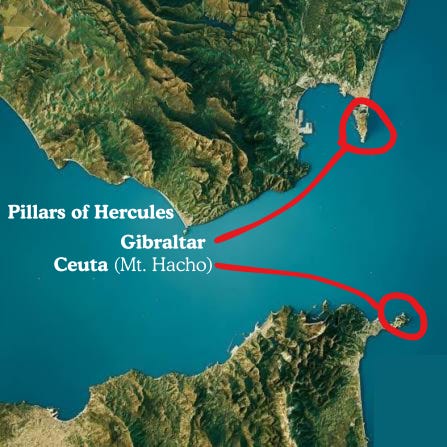
By 1704, when Spain lost the major Pillar of Hercules, Portugal had long ceded Ceuta to Spain, first through the unified Spanish-Portuguese kingdom and then after Portugal regained independence through a formal treaty in the seventeenth century. Portugal had first turned Ceuta into a garrison city, and place for convict exile, “so that it became Portugal’s Siberia; what had once been one of the great cities of the Maghrib had to all intents ceased to exist as a city, and it never recovered its past glories” (Abulafia, The Boundless Sea, p. 478). Spain held onto the fallen city, together with another exclave Melilla to the East on the Moroccan coast, while its American global empire crumbled. For a few years during the Napoleonic Wars the British Empire greedily seized the second Pillar of Hercules and occupied the city for five years, but it was returned to Spain at the Congress of Vienna. Throughout Greater Europe’s nineteenth century of colonial expansion, Spain did not break out from the city to colonise the surrounding area of Morocco.
It was not until Spain’s catastrophe of 1898, when a US American war of aggression seized Cuba, Puerto Rico and the Philippines from the Spanish Empire, that Spain began to colonise parts of Morocco as a protectorate, with other parts controlled by France. The national humiliation, known as the “Disaster of 1898,” drove Spain to colonise in compensation for their shame. It fuelled the dreams of Spain’s imperial conservatives to cradle a new Reconquista in this little African empire, and their dream of an “Iron Surgeon” who would sweep away the weak liberals or dangerous radicals of Spain who had let the empire and traditional values go. The conservative dreamers had their wish fulfilled when General Franco - known as the leader of the Africanistas because his power base was in Spain’s North African colonies - launched the Spanish Civil War in 1936. The first battle of that Reconquista of Spain on behalf of Catholic, conservative, imperial Spain occurred in Ceuta.

Spain let go of its recently colonised territories in North Morocco in 1956, after decades of local resistance and repression, and after France relinquished its hold over French Morocco. This act of decolonisation, while the Algerian War of Independence raged, buried internal conflicts, including the dispute over the Western Sahara in which a post-colonial nation repressed a claim for self-determination of the Western Sahara Polisario front. But Franco did not relinquish Ceuta. Its special history as an administered city of the Iberian Crowns since 1415 made it the exception it remains today.
This tangled history of decolonisation conditioned how migration was weaponised in Ceuta in 2021 and in 2026. But it is not the whole story.
Fears of Fragmentation, Right and Left
The deeper story is fear. Fear of migrants. Fear of strangers. Fear that a flash mob the size of a small football crowd represents an “invasion” that exposes allegedly “borderless” Europe. Fear of interdependence and our need for strangers, like all those irregular migrants in Spain or Mexican workers in the USA, who do the dirty work others avoid. Fear that society is fragmenting in ways that make impossible a single cohesive identity for Europe, or Australia, or the West, or any other imagined political community. Fear that entanglement with other cultures will undermine the invented tradition of Western civilization.
The illiberal right has long exploited these fears radiating out from spectacles of “mass migration” and border breaches. Australian readers know this very well. This country has been a migrant country since long before 1788, as historian Mark McKenna showed in his The Shortest History of Australia. Yet since 2001 our political discourse has been scarred by recurrent grande peurs related to migration, refugees, asylum seekers, the tragic deaths at sea of vulnerable people seeking refuge or a better life here, and the ruthless exploitation of those fears by politicians of Left and Right.
The Ceuta incident, and Europe’s debate on policy and operational responses to irregular migration, brings back bad memories of the last twenty-five years of migration controversies in Australia. While there were many debates about migration in Australia in previous years - both the ‘White Australia Policy’ and Multicultural Australia - 2001 marked the origin of the West’s current debate on migration because of the Tampa incident.
Between 26 August and 3 September, 2001 - yes, one week before another incident that brought us the war on terror and provoked refugee crises around the world - a high drama occurred off Australian waters in the Indian Ocean. In August 2001 Australian troops boarded the Norwegian freighter MV Tampa off Christmas Island, an Australian territory. The commander of the vessel, Captain Arne Rinnan, had rescued hundreds of asylum-seekers from a stranded Indonesian fishing boat in the Indian Ocean and was attempting to bring them to Australia. He believed he was acting in a humanitarian spirit and in accord with the law of the sea. But the Australian government was determined to keep “illegal migrants” far from this island home. The ‘Tampa Crisis’ birthed Australia’s new ‘border protection’ policy and the Pacific Solution, by which asylum seekers were transferred to Nauru and Manus Islands, in atrocious conditions, rather than being processed on the Australian mainland. The policy and methods have since been progressively incorporated into migration and border control policies in Europe and North America.
Of course, the “Pacific Solution” - embraced by Liberal and Labor Prime Ministers ever since - was never a complete solution. It broke many Australian hearts and destroyed many political and bureaucratic careers. In 2013, following many breaches and tragic deaths, a new government, which was elected primarily on a “Stop the Boats” mantra, implemented tougher measures, coordinated through the military agencies, including “tow backs” of the boats to Indonesia. The methods were cruel - supporters of the policy would say cruel to be kind - but, supported by changes in conditions and a raft of coordinated policies, they worked, at least enough to stop the flow of refugee boats and to force a consensus among the Australian governing elites, left and right, in favour of tough border protection policies. The conservative Prime Minister who stopped the boats, Tony Abbott, did not last long in office, but has ever since promoted his success to Europe and the Conservative Internationale. Over the last week, Nigel Farage of Little Britain announced Operation Fortress to “stop the boats” and “to protect this country from invasion.” He exploited fears of the border incident at Ceuta, and replicated the Australian policy to tow back small boats across the Channel to France. Tony Abbott, in turn, again called Ceuta an “invasion” and accused the Europeans of being weak.
This sad story demonstrates that ideas and practices spread from the outer periphery to the imperial core. It is not only a story of policy practices. Australians, including Tony Abbott and former Deputy Prime Minister John Anderson, friend of Jordan Peterson, have been prominent in that damp wing of the Conservative Internationale, the Alliance of Responsible Citizenship. While I feel vindicated in one of my pet theories about core-periphery dynamics, I am just so sad and ashamed that cruel border protection policies should be Australia’s preeminent contribution today to global policy.
Fatefully, however, stopping the boats did not stop the fear of migration, nor the underlying fears of the loss of identity, belonging, and recognition. Those fears, and resentments over social issues such as the cost of housing, have pushed a previously marginal Australian right-wing party, One Nation, to the top of the polls. It has driven panic and division within the insipid left-wing Australian Labor Government, that again cannot settle on a migration policy. It has fragmented and reordered conservative politics, with predictions of a new conservative coalition government, led by veteran of Australia’s 1990s Asia migration scare and figure of fun, Pauline Hanson. A far-right party, like the AfD, could govern Australia after the expected 2028 election. If this scenario occurs, the influence of the periphery has again spread to the core. One Nation was founded in 1997. The AfD in 2013.
Parties like One Nation, the AfD, MAGA and the French Rassemblement National (whose name changed from the notorious Front National, associated with Marine Le Pen’s father, in 2018) exploit fears of migration and rampant social fragmentation. But they do more than that. If the challenge of responding to these parties banging on the doors of the government chambers is to be met, we need to understand how these parties, as much as mainstream parties, create cohesive national, or civilizational, political myths to ward off social fragmentation and the fear of strangers. One Nation is an assertion, against the facts, but with desperate hope, that there is one cohesive nation to which “we belong.” Marlene Laruelle has argued against mockery of the alt right and for the search to understand this lived experience of illiberalism.
Behind the RN’s proposals lies a coherent anthropological claim that their opponents have consistently underestimated: that nations are not administrative constructs but living communities of shared history.
Marlene Laruelle, The Invention of Two Frances: When Politics Empties, Identity Rushes In
“France is reorganizing around two rival definitions of what the nation is and what it is becoming,” wrote Laruelle. She pointed to the idea of a “continuous, rooted, culturally legible nation now under threat” that underpins the populist right-wing nationalist and anti-migrant rhetoric in Europe, America and Australia. On the left, she observed:
Jean-Luc Mélenchon, leader of leftist La France Insoumise, launched his 2027 presidential campaign in front of the Basilica of Saint-Denis, the necropolis of the kings of France, in a deliberate attempt to anchor his “New France,” a creolized and plural political community, within the deepest strata of national history.
Marlene Laruelle, The Invention of Two Frances: When Politics Empties, Identity Rushes In
It was from this article that I learned of the concept of créolisation, that I have begun to integrate into my own thinking about identity, belonging and the intermingling of cultures.
The “New France” intellectual scaffolding comes from an unlikely source: the concept of créolisation, developed by the Martinican philosopher Édouard Glissant as part of his vision of the “Tout-Monde,” a cosmological and poetic refusal of all hierarchies between cultures, including, and especially, the hierarchy imposed by French republican universalism.
Marlene Laruelle, The Invention of Two Frances: When Politics Empties, Identity Rushes In
No such poetic, intellectual concepts are likely to save Australia from the vapidity of its current electoral politics. But I do believe some adaptation of this idea, some acceptance of the radical fragmentation of societies and the tangled intermingling of all national and civilizational cultures is essential to calm the fears of migration and the end of Western civilization as we know it.
Biljana Vankovska wrote something very wise in this spirit in her reflection on the Ceuta incident this week.
The deepest irony is that humanity itself would not exist without migration. Human history is, above all, the history of movement, encounter, mixing, and transformation among peoples from different regions of the world. The very civilization that today builds walls was created by those who once crossed them.
Perhaps it is time for the West to learn from the wisdom of civilizations that have endured for millennia: walls do not solve problems — they merely postpone them. The only sustainable solution to migration is not exclusion, but cooperation; not fear, but development; not walls, but bridges.
Biljana Vankovska, Ceuta as a Moment of Reflection: What the Crisis Revealed About Our World, 7 August 2026
Cultures intertwine, even as society fragments. We should not fear walking on either plane, despite the entanglement and fractures. But, especially in contemporary polities, defined by electoral choice and mass media spectacles, politics polarises. It drives a wedge between us and them in the hope that we are one per cent more than they.
For this reason, I vest more hope in culture and society than politics. For the same reason, I have long believed there are more virtues in governing, the responsible concern for others within common public institutions, than in politics. And certainly more than the tedious, opinion-poll driven nonsense of contemporary post-democratic politics.
I don’t force this disposition on anyone. It is a product of my individual biography, and the fatigue and defeats of thirty-three years as a government official who sought to practice the ordinary virtues of governing well, like talking to strangers. It leads me to embrace strange poetic ideas of “cultural politics”, like créolisation, even if they distance me from intellectuals of the Left who respond to the Right’s embrace of matters of civilizational identity and immigration by calling for a new polarisation of politics on the basis of class.
French historian and economist, Thomas Piketty has recently written:
The right wants to give the people more control over matters of identity and immigration. The left should do the same, but focus on solidarity and justice. In doing so, it would demonstrate that the anti-immigrant rhetoric of the Rassemblement National is a smokescreen meant to deflect social anger and protect the wealthy.
Thomas Piketty A referendum for another development model, 23 June 2026
His argument is based on a deep study of the sociology of electoral politics in France over two hundred years, and a diagnosis that France’s current dilemmas are caused by a tripartite political system, in which the population’s loyalties are split three ways along cultural lines, rather than a bipartite system of France’s best years, polarised by class.
But can the bifurcated social world of the Old Left ever be restored? Decades of social fragmentation have refashioned identities on other ideas of race, gender, migration, power, culture, location, class, habitus, environment and who knows what else. The days of two party systems are over. The hopes of one nation under god or scientific socialism are done. The myth of the class-conscious proletariat - which pushes aside the bourgeoisie and the peasants, or exterminates the kulaks, to lead History to Justice and Progress - is as shattered as the fragmented social experience of the real working class. It is time for radical acceptance of social fragmentation, rather than the polarisation of class.
The Lessons of the German Peasants War 1525
And that takes us back to my recent reflections on why I never was and never will be a Marxist, and my book of the month, Lyndall Roper, Summer of Fire and Blood.
There is a Marxist myth of history. All history is the history of class struggle. Struggle drives progress dialectically, from feudalism (lords and peasants) to capitalism (bourgeoisie and proletariat), through an unfortunate deviation through imperialism (to explain the role of non-European societies and the failure of the workers to unite), and, finally, on to the final stages of socialism, which is replaced, after the dictatorship of the proletariat, by the eternal bliss of communism.
One of the foundation texts of this myth, and arguably the first Marxist study of history, was Friedrich Engels, The Peasant War in Germany.
The German people are by no means lacking in revolutionary tradition. . . . In contrast to present-day enfeeblement which appears everywhere after two years of struggle (since 1848) it is timely to present once more to the German people those awkward but powerful and tenacious figures of the great peasant war. Three centuries have flown by since then, and many a thing has changed; still the peasant war is not as far removed from our present-day struggles as it would seem, and the opponents we have to encounter remain essentially the same.
Engels, The Peasant War in Germany, 1850
This early work set the pattern of the Left’s preference for polarised class politics, with one side representing Truth, Justice and Progress, and its forward march through history justifying revolution, violence and the occasional sneer at the “idiocy of rural life” or, in modern parlance, gilets jaune, populist deplorables and the anti-migrant working class.
In Summer of Fire and Blood, Roper discussed Engels, The Peasant War in Germany and Karl Marx’s more famous The Eighteenth Brumaire of Louis Bonaparte together as “two halves of a single intellectual endeavour.” Both were written between 1848 and 1850 in the wake of the failure of the revolutions of 1848. “Both also reveal,” Roper wrote, “the limitations of Marxism in understanding peasants and their communities.”
“Both interpret their subjects in the light of the forward march of history. In 1525, the early German bourgeoisie was not strong enough to push through its own interests, while the miners and other proletarians were not yet sufficiently numerous to win; whereas in 1848 in France, the proletariat could not overcome the bourgeoisie but had enough self-consciousness to know that its interests were not theirs. Both authors therefore relegate peasants to the sidelines of history. Engels sees them as part of an old feudal order and hence not truly revolutionary, and he assigns the key historical role to the bourgeoisie even though it was the peasants who acted.”
Roper, Summer of Fire and Blood, p. 379
Roper does not make the same mistake. She interprets the peasants not through the lens of false class consciousness. She does for sixteenth century peasants what Marlene Laruelle does for the twenty-first century political imaginary, including those illiberal Spanish Vox supporters shouting, “Spain is Christian, not Islamic.”
Politics is never only about institutions, interests, or power relations. It is also about ways of life, everyday practices, cultural codes, moral intuitions, social attachments, consumption—in other words, about lived ideologies. Political identity is expressed through branded clothing, flags, social media aesthetics, parallel media ecosystems, and boycotts or loyalty to specific companies. It is something one inhabits and enacts.
Marlene Laruelle, Vivatopia: Lived Ideologies and Political Futures
Roper similarly shows how the politics of the German Peasants’ War, though mostly illiterate, was still something inhabited and enacted, including through marching together in a brotherhood, religious concepts of freedom, and sharing homes with farm animals and the forces of nature.
It makes Summer of Fire and Blood an uncannily relevant work to understand the populist social uprising or peasants’ rebellion in the contemporary West.
If you are going to join me in reading Summer of Fire and Blood this month, then your reading experience will be improved by a simple, short guide to the characters, events and literature on this revolution that sits at the origin of both Western colonialism and modern political mythologies.
In the bonus section for paid subscribers, I have a free link to such a guide. Upgrade your subscription now, and get more from this fantastic prize-winning history.
Bonus Perk for Paid Subscribers - Guide to German Peasants War
And don’t forget paid subscribers can join the Live Call to discuss this history book on the last day of the month.
Thanks for reading
Jeff
Indeed, pace Biljana, migration is one of the great forces in history. All of North Africa is testament to this since they were originally Christian and now are Muslim. This didn’t happen because the Arabs visited on holiday, anymore than they were on holiday when they blundered into Charles Martel at Tours.
Make up your mind: if you do not approve of Western Colonisation, why is Islamic Colonisation alright? If you think one is and the other isn’t, you are not arguing against colonisation, as you appear to claim to be, just against colonisation by one group and not others, which is curiously the same argument as the anti-immigration forces you claim to deride.
More broadly, mass migration brings with it serious disruption, destruction, rape and misery. Yes, in time, it works itself out. Budapest is beautiful. Encountering the rampaging Huns in the fifth century probably wasn’t such a charming experience. You can hardly tell someone whose village or town is about to vanish: just lie back and take it because of the ‘irony of history...’ It is quite possibly one of the worst arguments now banging around. If you have a home, a village or a community, you must defend it if you think it has value. This is a truth accepted ALL OVER THE WORLD except in the West by delusionists. This means walls. Sure, have bridges too. You decide who comes in. I recommend excluding Hamas terrorists or anyone keen on FGM. You? Let them in? Historical process and all that?
It is remarkable that tens of thousands of mostly young men spilled over a border in a 24-48 hour period and the best you can come up with is conspiracy theories and the idea that the Spanish ought to have built a bridge, not a wall, to make it easier for them. There’s not the slightest chance if it had been the Spanish pouring over into Morocco you’d have the same view.
Immersed in Gerard Manley Hopkins, I took a break from this immortal diamond of a weirdo poet to look/see at what had come up on my screen in the previous 2 hours. “New” substack flag — Ceuta. I’d passed over this JR flash earlier this week, now I had to relent. And dove in. My comment: So lucid is JR, so specific, so compassionate, so smart, such decency and righteousness (think Hebrew prophets, Gershon Schlolem (sic?)—to redeem this word, now so out of favor as to be unspeakable).
Ceuta — What an informative (basic facts) and illuminating piece. What an unexpectedly hopeful glimmer too I found in the fact and aspiration of a “creole” civilization. … The kingfisher flashes! (Cf GMHopkins).
Just when I’m (among many many millions more) standing at the edge of abandoning all hope!