
The Revolution Will Not Be Televised. It Will Not Ever Happen, Again.
Reflections on revolution as the political dream to escape modernity
Revolution is the political dream of modernity. But the candle of modernity has burned out. Despite the modern longing for revolution, in its many forms - to overthrow the elites, to replace the system, to put the people united in charge, to transvalue all values, to remake the world in accordance with our perceived reality - the dream will not last our waking to a new day of history.
The Revolution will not be televised. It will not ever happen, again. The history of the world has escaped the modern age of revolutions.
The Revolution Will Not Be Televised
In 1971, Gil Scott-Heron, author of the song, The Revolution Will Not Be Televised, believed the reality of revolution could break through the society of the spectacle.
The revolution will not be televised . . .
Green Acres, Beverly Hillbillies, and Hooterville Junction
Will no longer be so damn relevant
And women will not care if Dick finally got down with Jane
On Search for Tomorrow
Because black people will be in the street looking for a brighter day
The revolution will not be televised . . .
The revolution will not be televised
The revolution will be no re-run, brothers
The revolution will be live.
The dream felt right at the time. It was three years after the global cultural rebellions of 1968, when French radicals embraced Algeria and saw the beach in surreal dreams under the pavements, and Mao’s Great Cultural Proletarian Revolution smashed the Four Olds. The Black Panther Party had not yet split on the questions of reform, revolution and violence. The Third World insurrection that was post-1945 decolonisation was organised and articulated principles to remake the global economy in the New International Economic Order, which would be endorsed by the UN General Assembly in 1974. Revolution was in the air across Africa, Asia, the Americas and Europe, East and West, with a turn against the crass consumerist, capitalist imagination the USA had televised since 1945. Even in Australia, icons of a social revolution prevailed: Germaine Greer, the election of Australia’s last social democratic Government in 1972, the social movements, and the radical historical thinkers who changed the nation’s story of itself, like Humphrey McQueen in A New Brittania, who believed, like Gil Scott-Heron, that the revolution was coming, that any day now people will be in the street looking for a brighter day. That people will give up their illusions, and the revolution would be live.
But Gil Scott-Heron and the radical dreamers of the 1960s and 1970s were wrong. The dream did not survive the madness of the day, nor the new formations of empire, global economy and liquid modernity that emerged after 1971. The revolution was televised, after first being tamed, sanitised, commercialised like any brand, and used to convert the dreamers of revolution themselves into a televised and later live-streamed spectacle. It turned out that - adapting the song- you will be able to stay home, brother. You will be able to plug in, turn on and cop out. You will be able to watch any time of day a televised fantasy of escape from history through revolution on YouTube or any social media of your choice.
How Global Revolution Dissolved in Liquid Modernity
The new formations of empire, global economy, and liquid modernity did not prevail without a struggle that kept the revolutionary dream alive.
The revolt of the Global South was crushed by empire and predatory economic hegemony through the 1970s, although it took two decades to complete. As Quinn Slobodian showed in Globalists: The End of Empire and the Birth of Neoliberalism, the new principles of political and economic order which, came to be known variously as neoliberalism, neoconservatism or the liberal international rules-based order, began to be institutionalised in the 1970s, including through the World Trade Organisation, as a reaction to the challenge to the West by the Global South. Despite the shock of defeat in Vietnam, and marginal domestic revolutionary revolts, the craving for hegemony was strongest in the USA. But, as Slobodian shows, it also had strong European and imperial roots in Von Hayek’s thought. Together, leading factions of the USA and Europe created a new phase of imperial dominion over the world.
But until the 1980s the new hegemony had not won, outside the USA. In 1980, Willi Brandt, former West German Chancellor and leader of Östpolitik, led an international committee - dare I say, representative of the multipolar world - that defined doctrinally the term, Global South, with the ‘Brandt line’ in the Brandt Report. The Great Southern Land of Australia was excised from the South.
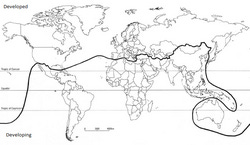
The Report challenged the USA-defined hegemony in favour of a vision of social and economic equality for humanity that would resolve the income disparity between the North and South, or the imperial and recently decolonised worlds. It brought the passion for revolution from the streets to cooperative reforms achieved at the diplomatic negotiating table. It sought a global “creative partnership in the use of a nation’s productive forces and its full human potential” that rejected universal models of development and modernisation imposed by the West. It recommended “an international meeting at the highest level…to discuss North – South emergency matters and…to reach agreements as concrete as possible, on how to turn certain mutual interests into creative partnerships, immediately and for the longer term.”
That recommendation led to the North–South Summit, or the International Meeting on Cooperation and Development, held in Cancún, Mexico, in October 1981. Historian Jeremy Adelman rightly sees this conference as a pivotal event in how the world managed interdependence during the 1970s and 1980s. The revolt of the Global South, and, across the world, the emergence of new dispositions towards the exploitation of people, natural resources and strangers, had given birth not so much to a revolution, but a wide, institutionalised network to reform international relations through new cooperative models.
But regrettably, as Adelman also notes, the USA had just elected Ronald Reagan, in a swell of pride in US American supremacy, after its humiliations of the 1970s (Vietnam, oil crisis, stagflation, political morality, questioning the American dream, and the Iranian Islamic Revolution). As Adelman also observed, the USA elite, led by B-grade movie actor, Ronald Reagan, was determined to crush the revolt of the North–South Summit. Nothing came of it, but forgotten dreams. The USA killed global reform in the crib. The Reagan Revolution of Christian conservatism, free-market capitalism, lower taxes, even smaller US American government, and crusading foreign policy against evil empires took hold.
This revolution was televised. By 1984, the television told US Americans that the nightmare of global revolt was over. “It was morning again in America,” as Reagan’s famous election advertisement reassured. By 1989, Green Acres, Beverly Hillbillies, and Hooterville Junction were no longer so relevant, but were replaced by Seinfeld, a show about nothing that caught the mood of the world in a state of liquid modernity. Two years later, the USA exported a free market revolution that brought down the Soviet Union. Gorbachev’s memory was transformed from political leader, who negotiated the end of the Cold War, to the amusing star of a Pizza Hut commercial. The US American and Western public developed a taste for staged and televised revolutions, in other people’s countries. They can indulge them without the suffering, deprivation, disorder and violence that has followed so many such revolutions, artfully stage-managed by intelligence agencies, think tanks, and media corporations, ever since 1989.
Revolution was not only televised. It became the symbol of liquid modernity itself. The historical concept melted into thin air, becoming an empty advertising slogan. After 1991 especially, a sanitised, cosplay version of the American Revolution prevailed in the global political imaginary. The idea was tamed, commercialised, and defanged through misreading all the other examples. Revolution lost all sense of tragedy. All sense of fear. It was uprooted from the history of those world-shaking events around the world, from the USA in 1776 to Iran in 1979. It became a new season of Colour Revolutions. More broadly in the culture, revolutionaries became just people doing their own thing. Revolutionaries became stylish live-streamers, not the hard men who practised terror, violence and ruthless ideas from Robespierre to Pol Pot. They became T-shirt wearing app launchers, not the social engineers of a new humanity. Everyone could refashion their self and begin anew in a revolutionary way. But these new beginnings required no great social transformations. It was enough just to dream them. Revolution became the escape room of political virtual reality.
Revolution & Empire Born Anew
“The modern concept of revolution,” Hannah Arendt wrote in On Revolution, “inextricably bound up with the notion that the course of history suddenly begins anew, that an entirely new story, a story never known or told before is about to unfold, was unknown prior to the two great revolutions at the end of the eighteenth century.” Published in 1963, Arendt’s reflections on revolution compare the revolutionary traditions born by those two great revolutions in North America and France. The book celebrates the American revolution as an act of freedom and natality, in contrast to the French submission to historical necessity and violence. By way of the French revolution, Arendt criticised, in conventional Cold War USA émigré terms, the Russian revolution, and, without naming them, the revolutions and anti-colonial uprisings occurring in 1963 across the Global South.
“The sad truth of the matter is that the French Revolution, which ended in disaster, has made world history, while the American Revolution, so triumphantly successful, has remained an event of little more than local importance.”
Arendt, On Revolution, p. 56
Arendt’s political, philosophical judgement reads today as just another silly American love song written by its post-1945 émigré elite. Arendt expressed the conventional exceptionalism of post-1945 Atlantic history, and the myth that the USA revolution broke from an empire to found a nation, without violence, in the idea of liberty. The myth is repeated still ad nauseum in parts of the USA academy and every social media platform. But more than six decades of history writing since Arendt have exposed the fallacies of On Revolution. In particular, Jeremy Adelman “An Age of Imperial Revolutions,” (The American Historical Review, 2008) reconceived the extent to which an entirely new story - a story of a national republic and not a tyrannous empire - unfolded in the US American Revolution. Adelman argued that, during the Age of Imperial Revolutions (broadly 1770-1830, and including many more revolutions than the two mentioned by Arendt), old declining empires did not give way to young and free nations. A transnational imperial-state system metamorphosed behind a banner of liberty. His influential interpretation bolsters Nel Bonilla’s analysis of the Bunker State and today’s reconfiguration of empire in the new conditions of redistributed power.
It was a crisis of and within empires that spawned social revolutions, not revolutionary claims that raised fundamental questions about state structures. . . . sovereignty remained as equivocal as ever: empire and territorial aggrandizement at the expense of neighbours did not cease to be a common way to quench the recurrent drive to align territoriality with states, now justified in the idiom of the “nation” while carrying with them traits of old empires that would be projected inward.
(Adelman, “An Age of Imperial Revolutions,” 2008, p. 339)
These revolutions were not, as Arendt believed, in the tradition of modernity, spectacles in which “history suddenly begins anew” and an “entirely new story unfolded.”
Instead we find a process in which old and new practices and understandings of sovereignty were reassembled, often in a desperate effort to prevent political order, and the social inequities that sustained it, from vanishing altogether.
(Adelman, “An Age of Imperial Revolutions,” 2008, p. 339)
I will return to Adelman’s argument, and the echoes of the Age of Imperial Revolutions in our own Age of Multipolar Revolutions, later in the year, in a Long Read on the intertwined history of decolonisation, nation, empire and other forms of transnational state.
Revolution and Modernity Hang Together
For now, however, I want to focus on the pairing of revolution and modernity in historical thought since the Birth of the Modern Age. Both Revolution and Modernity are, in Arendt’s words from On Revolution, “inextricably bound up with the notion that the course of history suddenly begins anew.” Modernity in culture and politics breaks with the past. It provokes revolutionary change, not the mere adaptations of amelioratory reform. It gives birth to the New World. It raises its children in the turmoil of permanent revolution and constant change.
Only in the USA, in the fairy tales of its imperial historians, did the Saturn of modern revolutions not eat those children, unlike those in France, Russia and China. But that was enough to preserve the belief that a revolution was possible, without violence and without the messy compromises that emerge from negotiation with the others on whom we depend. The Old System could be torn down by a tweet, a slogan and a protest march, just like that show on TV. And how would life, government and power élites be sustained on the day after the revolution? That was never in the dream. That was never televised.
Late Modernity has many definitions, including the post-modernity of Lyotard and Baudrillard that examined the society of the simulacrum, and the liquid modernity of Zygmunt Bauman, which brought the permanent revolution home in the inner life of the consumer. Lyotard and Baudrillard believed modernity ended in the late twentieth century; for convenience let’s date the rupture to the year, 1968.
1968: This is the Dawn of the Age of Liquid Modernity

If human character changed in 1910, then, in 1968, everything, absolutely everything, about human character became politically unstable, or worse, ‘historically contingent’. The human could change at any moment. Or so some European intellectuals of 1968 believed. Welcome to the Age of Liquid Modernity.
Bauman, on the other hand, saw liquid modernity as the transformed state of the same age of modernity, that some stretch back to 1500, some to 1776, and, in its cultural modernist version, Virginia Woolf proclaimed, changed human character in December 1910. I have come to speculate, in my 2025 series on world history, that the age of modernity, in all its forms, prefixes and states, is over.
We do not have a word to describe this new cultural condition; but the world as a whole no longer seeks to break from the past. It no longer pursues universal modernisation based on ideas never tried before. It no longer has faith that following this political pamphlet, this declaration of war, or this manifesto of a performance artist, the course of history will suddenly begin anew.
One leader of the multipolar world, Vladimir Putin, has even renounced the term, reminding his audience that Russians, after five blood-stained destructive revolutions in the twentieth century, have had enough of revolution for now. With millions dead, and generations traumatised, including during the most recent revolution engineered by free-market Americans in the 1990s, you can understand that both Western modernity and revolution have lost appeal in Russia.
If modernity is over across the world, can its political dream, revolution, long survive?
If Not Revolution, Then Turbulence
To answer that question we might reflect on a revolution on the threshold of early modernity in 1525, the German Peasants’ War.
“Every revolution must be nourished by dreams of a new world,” wrote Lyndall Roper in Summer of Fire and Blood: The German Peasants’ War. She wrote of a rebellion of the preliterate against their modernising lords, as the mentalities of the Old and New Worlds clashed violently in the Americas, and in Asia, Africa and in Europe. But this revolution did not describe itself as such, although Roper judges the scholarly historiographical concept of ‘revolution’ does fit this large-scale transformation. Instead, the contemporaries of that upheaval, “nearly universally called it the ‘Aufuhr’, the turbulence, a word that captures its disruptive motion.” (p. 377)
But since the nineteenth century, the term ‘revolution’ has replaced that evocative term used by the peasants who revolted and the lords and priests who suppressed them. Ironically, one legacy of the Peasants’ War was to bury the meaning of their dreams beneath historical theories of revolution.
“The German Peasants’ War had legacies greater than its immediate and even longer-term consequences. These are not just historical but intellectual and political, as the event became a primary battleground for arguments between right and left, and a test case for the study of revolution in all periods. . . indeed, Karl Marx and Friedrich Engels themselves developed their theories of revolution and progress by studying it.”
Roper, Summer of Fire and Blood, pp. 377-378
But book theories of revolution did not do justice to the dreams that nourished the peasants and drove them onto marches, visions and failure in that summer of fire and blood. Roper recovers those unwritten, not wholly rational dreams from two centuries of arguments about modern revolutions.
The revolt was not brought about by sets of ideas in books; it unfolded as people applied Reformation ideas they had heard to their own lives and experienced together what change could mean. Dreams were part of the heady atmosphere of the times, visions and prophecies, and utopian blueprints for a new future.
Roper, Summer of Fire and Blood, p. 147
Those dreams drew inspiration from Biblical texts and peasant communal life. They did not converge into a single doctrine, nor seek a false uniformity. They revealed, “the growing gulf between the scripture-based piety of a reformer like Luther and the revolutionary spirituality developing among those engaged in the Peasants’ War.” This revolution was not televised. Its main actors did not even write it down.
Marx and Engels took from the failure of this revolution a scorn for religious ideas and the ‘ecstasy’ of revolt. The proletariat, not the peasants, would be the class to lead world to modern socialism. But, Roper argues, they misunderstood the nature of the peasants’ turbulence.
Religion was not a cloak or guise for expressing something else, but a profound worldview that changed lives and aimed to transform society. It included emotions, the ‘ecstasy’ of revolt that Marx disdained but without which people could not have acted. Indeed, revolutions must be explained in terms of beliefs, experience, and emotions as well as social conditions.”
Roper, Summer of Fire and Blood, p. 388
All the real modern revolutions - not the endless revolutions of taste and consumer preferences, but the events that shook the world like Russia in 1917 - similarly arose from a turbulent mix of those beliefs, experiences, emotions and social conditions. From that turbulence, in turn, arose action, organised, spontaneous and too often violent action; people on the streets, not people at home, plugged in, turned on and copped out.
But in the conditions of the world after modernity are such revolutions possible? The transnational Bunker State has no single Winter Palace to seize. Amid proliferating social fragmentation, no class, no party, no single elite can lead revolutionary change for the masses. Culture has turned away from modernity to sustain traditions, as fragmented as the societies they serve. And, in our heart of hearts, we know our degraded democratic rituals of people power resemble the Hunger Games more than the Storming of the Bastille.
In my vision of history, at least, the dream of revolution has died. I believe the political dream of revolution, and all of its cognates,, such as total systemic change, will not survive long beyond the death of modernity. The Revolution will not be televised. It will not be live-streamed. It will not ever happen. The world has escaped the modern age of revolutions. It is time to detach our political dreams from revolution, and reimagine history with other metaphors, without two centuries of modern intellectual baggage and violent revolutionary practice.
But that does not mean that dreams of change in our shared lives cannot be sustained. We may, however, do well to call those hopes and fears by another name.
Could turbulence be such a term for our age? It is better than revolution, polycrisis, or rupture. It does not demand the violence of direct action. And, unlike the revolution, that turbulence will be both televised and live.
Thanks for reading
Jeff
I fear you're right, and it's somewhat discouraging, since mindless counterrevolution is on the march in the USA under the maga flag, and everywhere else the regime can export it. The far right thrives in turbulence, as long as they can spin the narrative their way, so I don't see much hope there
The U. S. revolution (so called) was merely a mirror of European imperialism & religious mania of it's time. It committed genocide on natives & stole free labor from Africa.
The article seems to suggest that revolution is pointless &, without democracy, it probably is.
The 'missing link' between Apes & humans is us. Where you have oppression you have resistance. We Irish marched for Civil tights in 1969. Got denied with a murderous response from the state - hence IRA etc.
Nothing is inevitable! We now, once again have Pax Britannica, heading toward the murder machine of NATO!