
The Surprising Connection between the Conquistadores and our own New World
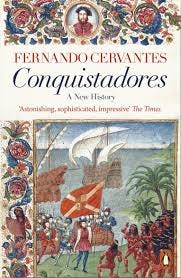
World History Book Club, Cervantes, Conquistadores: A New History
Welcome to the second instalment of the monthly History Book Club. This post provides a reader’s guide and discussion questions for Fernando Cervantes, Conquistadores: A New History (2020).
Want a recap on how the Book Club works? The end of this post outlines:
The 2026 World History Book Club Program
How you can participate in the discussion, including the monthly live call.
The historian
Fernando Cervantes is a Mexican-born historian of early modern Europe specialising in the intellectual and religious history of early modern Spain and Spanish America.
He seeks to understand and recreate the religious and intellectual worlds that shaped the Spanish conquest of the Americas, rather than to condemn them from the perspective of contemporary standards. Indeed, he is a cultural historian of this era, including of the Inquisition and early modern humanism, as in figures such as Miguel de Cervantes, Montaigne and Shakespeare. He also writes with the perspective of a lay Dominican to get inside the religious mindset which drove the Conquest with seductive illusions, but from which most of us today are quite remote. However, his work draws on multiple perspectives to provide a rounded account of both the Spanish mental worlds and those of the societies (the Mexica/Aztecs, Inca and others) they encountered.
His earlier works include:
The Devil in the New World (1994)
Spiritual Encounters: Interactions between Christianity and Native Religions (1999)
The Hispanic World in the Historical Imagination (2005)
The Inquisition (2006)
Angels, Demons and the New World (2013)
Cervantes teaches at the University of Bristol, and you can assess him yourself by watching this video presentation of his history of the Conquistadores.
The book
In Conquistadores, Cervantes recreates the mental worlds of both indigenous Americans and the Spanish conquerors, colonisers and religious critics. By focussing on the surviving archival records - diaries, letters, chronicles, polemical treatises - he tells a seemingly familiar story in a profoundly new way.
He directly challenges anachronistic condemnations, propagandistic Black Legends, and nostalgic apologetics. The real story beneath the thick crust of accumulated legends is much stranger than fiction. And uncannily relevant to our own time; this was the event that inaugurated 500 years of Western expansion which Marco Rubio celebrated in his Reconquista speech at Munich.
Examining the Conquest with full imaginative empathy is morally and psychologically challenging. The scale of death, cruelty, violence, rapacity and irrationality freezes our hearts with the Gorgon effect, as described by Inga Clendinnen. This historian of the Aztecs described this effect as “the sickening of imagination and curiosity and the draining of the will which afflicts so many of us when we try to look squarely at the persons and processes” involved in events such as the Holocaust, the human sacrifices of the Aztecs, the Spanish conquest, events in Gaza, or indeed the sorry history of the USA’s 250 years of wars of conquest. I wrote more about the Gorgon effect here:

Clendinnen stared down the Gorgon of the Holocaust and the Aztecs through the mirror of imaginative empathy. She sought to understand victim and perpetrator, witness and silent bystander, apologist and denouncer. She looked into the face of the real Gorgon, not sentimental fictions nor ideological myths that offer emotional reassurance to the fabulist.
Cervantes does the same for the Spanish Conquest. He presents the complex characters and plural moral perspectives of victim and perpetrator, apologist and denouncer, emperor and priest, European and Meso-American. He tries to understand them in their terms, rather than through our response to their crimes; and let us be clear, Cervantes does not excuse those crimes. He tries to see them without our accumulated shame.
“the way we view and condemn the conquistadores often tells us much more about our own sense of shame in the face of the devastating effects that the expansion of Europe has had on the world and its environment than it does about the people who first initiated those processes without an inkling of where they would lead.”
Cervantes, Conquistadores, p. xvi
The Spanish Conquest that initiated 500 years of Western Expansion was a baffling, tragic encounter, a dance with strangers, to use the title of another of Clendinnen’s books about a later event in that expansion, the arrival of British colonists and convicts in Australia. The discovery, conquest, and realisation that the Americas were part of a bigger world was bewildering to its contemporaries. The violence and devastation there was as morally challenging and shameful to some contemporaries, including Bartolomé de Las Casas, Charles V and leaders of the Mexica and Inca, as it is to us today. The Conquest changed minds, not only maps. Its participants, on all sides (and there were more than two), had to adjust their mental maps of the world to a literal New World. Instead of a fast route to China and the Spice Islands that bypassed the Ottoman Empire, they had to conceive a world with the continent of the Americas and the Pacific Ocean. The world got bigger not smaller, and the dance with strangers did not go to plan. It rapidly spun out of control with devastating unintended consequences, unpredictable results and unique pathways through history. Contemporaries of the Conquest had many moral responses to the tragedy that unfolded before their eyes and in the reports they heard or read in obscure confusion far, far away in Europe. Neither the full tragedy, on all sides, nor the fertile response to the moral bewilderment are conveyed in conventional accounts. The Anglophone world’s stereotypes of the cruel Spanish empire and its zealous inquisition (‘Nobody expects the Spanish Inquisition!’) are the product of centuries of Anglo-American imperial propaganda. The US American Western civilization program view of Columbus as a proto-American pioneer who bravely went where no one has gone before is an arid cliché. It is a dead idea that can never die, as in Marco Rubio’s song of praise to 500 years of Western expansion since the ‘Age of Columbus’:
“Our story began with an Italian explorer whose adventure into the great unknown to discover a new world brought Christianity to the Americas – and became the legend that defined the imagination of a our pioneer nation.”
Marco Rubio, Munich Security Conference Speech, 14 February 2026
The real story is far more intriguing than that.
In the wake of the capture of Granada and the expulsion of the Jews from Spain in 1492, Europeans were unexpectedly faced with the challenge, at first gradual but ultimately unavoidable, of having radically to redraw the map of the known world to accommodate a new reality - not the quick path to the riches of the ‘Indies’ for which cash-strapped monarchs had hoped, but an astonishingly large and hitherto unknown continent.
Cervantes, Conquistadores
They did so not as cartoon villains nor propaganda heroes. They did so with all the cultural, social and all too human fallibility that we display in making sense of our own new worlds.
Cervantes tells the story in three parts.
Part One, Discoveries, 1492-1511, tells the real story of Columbus’ voyages, the real factors at play in the Spanish and later Habsburg court, and the early encounters with Caribbean societies.
Part Two, Conquests, 1510-33, traces the stories of Cortés and Pizarro, Moctezuma (Mexica/Aztecs) and Atawallpa (Inca), Charles V and Bartolomé de Las Casas, and many more besides.
Part Three, Disenchantment, 1533-42 narrates the loss of faith in the conquistadores’ enterprise, and the ways in which the Spanish empire rethought and reorganised the governance of the New World in a way that would survive for three centuries, contrary to the usual legends of the Spanish Empire.
He concludes the book by proposing a middle way between the Black Legend of the cruel Spanish Empire, spread by British and Anglo-American propagandists from the 1500s till today, and the exalted evocation of the Romantic imagination and pioneer spirit, spread by North American strategists and European sentimentalists today. This middle way takes us to an issue much discussed on the Burning Archive: how to conceive the grand sweep of world history by decentring the nation state.
“This requires a perspective that avoids the tendency to give pride of place to the unitary nation state in our understanding of politics, and to technique and empirical efficiency in our understanding of knowledge. For it is only by placing the conquistadores in their pre-nationalist and pre-empirical context that we can have any hope of appreciating the medieval religious culture that motivated them and which, in turn, laid the foundations of a non-unitary system of government that survived for three centuries without a standing army or police force and with no major rebellions.”
Cervantes, Conquistadores, p. 355
The story of the first three hundred years of Western expansion, it seems, is not what Marco Rubio, John Mearsheimer or history-blind nationalists around the world think.
Questions for discussion
Queen Isabel — Cervantes writes, “Queen Isabel’s death in November 1504 deprived the natives of Hispaniola of their most devoted defender” (p. 64). How is Cervantes’ portrait of Isabel’s and co-monarch Ferdinand’s intellectual and political response to Columbus, the expulsion of the Jews, and the Spanish conquest of the Americas different to what you imagined?
Columbus — In what ways does Cervantes portray Columbus as a man driven more by medieval religious imagination than by modern ambitions of exploration, knowledge or profit?
Cortés — How does Cervantes challenge the traditional image of Cortés, and what alternative explanations does he offer for his actions and relationships with local leaders?
Tenochtitlan — Cervantes writes of Tenochtitlan, “Although a great victory had been won, the price was disproportionately high. The mood was marked by a melancholy that none of the sources was able to hide” (p. 189). How do you respond to Cervantes’ retelling of the story of the capture of Tenochtitlan?
Bartolomé de Las Casas — How does Cervantes’ portrayal of Las Casas and his relationship with the imperial court differ from Greg Grandin’s in America América?
Charles V — How did Charles V govern the ‘Spanish Empire’, as Holy Roman Emperor during the Reformation, a Burgundian ruling Spain, and a remote authority seeking to restrain or balance both conquistadores and religious missions in the New World?
Pizarro — How does the conquest of the Inca by a small, ill-coordinated band under Pizarro force us to reconsider conventional explanations of why the Spanish were so militarily successful in the Americas?
The Inca — How does Cervantes use the Inca perspective to illuminate the ways in which internal divisions and differing interpretations of the Spaniards’ arrival fatally undermined any unified resistance?
“Obey but do not comply” — What does the Spanish colonial legal culture embedded in the phrase - obedézco pero no se cumplo - reveal about the relationships between power centres in the core and the periphery of the Spanish American empire?
Governance of Spanish America — How does shifting focus from the unitary nation-state contribute to a different assessment of the Spanish Empire as a “non-unitary system of government”?
World History Book Club Program
As set out in my January announcement, here is the schedule for the next eight core books we will read and discuss together in the book club.
April: Felipe Fernández-Armesto, Straits: Beyond the Myth of Magellan, together with the movie, Magellan
May: Mark Mazower, Anti-Semitism: The History of a Word
June: Sophia Rosenfeld, The Age of Choice: A History of Freedom in Modern Life
July: Mark B. Smith, Exit Stalin: The Soviet Union as a Civilization, 1953-1991
August: Lyndal Roper, Summer of Fire and Blood: The German Peasants War
September: Robert Darnton, The Revolutionary Temper: Paris, 1748-1789
October: Martin Thomas, The End of Empires and a World Remade: A Global History of Decolonization
November: David van Reybrouck, Revolusi: Indonesia and the Birth of the Modern World.
The February discussion of Greg Grandin, America América was in this post. Thanks for all your comments and participation.
How You Can Participate in the Discussion
This post provides a reader’s guide and set of discussion questions.
Over the whole month, you can share your ideas, comments, questions, responses and media recommendations in the comments section of this post.
I have made this feature available for paid subscribers so I can commit the time and attention to ensure the book club is a history salon experience. So if you have not already, why not upgrade now?
Mid-month, I will post an essay on a classic history text that has influenced me and is complementary to the core book. In March, I will share what I have learned from Inga Clendinnen, including her classic history of the Aztecs and her brilliant Dancing with Strangers, which describes the first encounters between the First Fleet settlers of Sydney and the indigenous people of that place. In a way her book wrestles with a similar case of tragic encounters and misread cultures.
At the end of the month, there will be a live call via Zoom, on Tuesday 31 March - a weekday time this time, rather than the weekend.
It is hard to balance time zones across Europe/Africa, Asia, West Pacific and the USA, here from Australia. February’s live call was at 10 am (UTC +11), which is harder for people in Europe/Africa. My plan is to rotate between schedules that suit different time zones, and want to get a sense from you about which times suit most people.
I have a quick poll on your preferred times to attend in March, and will schedule accordingly.
I will confirm the time in two weeks, so please let me know your preferences.
Enjoy your month’s history reading.
🙏❤️
Jeff
This was such a great introduction to the book, I will start reading this evening, but I think this is a book I want in a hard copy, so I'll read my Kindle version until the hard copy comes on Friday.
I was so impressed with your chat with Pascal today. It really helped me see through the lies of Trump and Starmer. Your clm anylsis was such a contrast to the nonsense and obfuscation of the BBC and Murdoch's rags.