
Decolonisation IV: India and the complexity of the colonised mind
Does colonialism begin and end in the mind? The case of decolonisation in India makes me think yes, and no. But then again, maybe.
Decolonising the Mind: Yes and No, or Maybe
The global icon of decolonisation in India, Gandhi, would suggest, yes.
Gandhi’s path of non-violence and satyagraha (truth-force) has inspired billions of people around the world to believe that the captive mind can bring an end to empire, or tyranny, by a moral decision to resist and to choose freedom. In Hind Swaraj [Indian Home Rule] (1909) he told the meek masses of India that the British soldiers and compradors did not shackle India, the colonised Hindi mind kept the Raj there.
Later in 1942, he campaigned for Britain to Quit India, in the depth of the British Empire’s strategic abyss of the Great Imperial War. Even though others advocated violent struggle, and even alliance with the Japan that had crushed European, North American and Chinese empires in Asia over the past decade, Gandhi sought to overthrow the British Empire by the force of truth and the courage of the decolonised mind. The essence of freedom, for Gandhi, was in the mind. In 1920, in the wake of the Peace of Versailles granting self-determination to chosen nations within Europe - but not to West or South Asia - and the appalling 1919 Jallianwala Bagh (formerly Amritsar) massacre, Gandhi told Congress, “if the Parliament fails us and we are worthy to call ourselves a nation, we must refuse to uphold the Government by withdrawing cooperation from it.”
This principle would be tested and challenged by other strategies to achieve independence over the next two decades. But Gandhi held firm to his belief that decolonisation began in the mind. He told his Mumbai audience in 1942, “the bond of the slave is snapped the moment he considers himself to be a free being.” This truly free, decolonised mind would not fight, nor attach itself to, the worldly commitments of power. The dharma of satyagraha was to free the colonised mind, and not to direct the action of the independent republic. To that same audience in 1942, Gandhi explained how his principled politics would not seek to control the fruits of action.
Ours is not a drive for power, but purely a nonviolent fight for India's independence. In a violent struggle, a successful general has been often known to effect a military coup and to set up a dictatorship. But under the Congress scheme of things, essentially nonviolent as it is, there can be no room for dictatorship. A non-violent soldier of freedom will covet nothing for himself, he fights only for the freedom of his country. The Congress is unconcerned as to who will rule, when freedom is attained. The power, when it comes, will belong to the people of India, and it will be for them to decide to whom it placed in the entrusted.
Gandhi, All India Congress Committee, at then Bombay, 8 August 1942
Gandhi’s commitment to principle made him, to many outside India, a modern saint. But, when Independence came, and with it, Partition - its violence, panicked migrations, mass resentments and chaotic withdrawals of authority - Gandhi and his principles were not much help to stabilise the situation. Gandhi withdrew into the comforts of an old belief that “satyagraha was not for the many but for the select few.”1 He was overwhelmed by events, events, dear boy, and the violence of a Hindu partisan assassin, who blamed Gandhi’s weakness for Partition. The free mind, living in truth, might begin decolonisation, but action, institutions, practical judgement, worldly resources, and, even at times, violence were needed to see it through, make it stick, shake off saboteurs, and create peace, prosperity and common wealth from the freedom of his country. That task fell, from 1947 to 1964, to Jawaharlal Nehru.
Decolonising the Mind: No
Consequently, many in India today remember Gandhi as a fallen guru, not a political saint. They say, No, colonialism does not begin and end in the mind. They say decolonisation must stand on firmer ground than the spirit. It must channel more chthonic forces than satyagraha, even at times politically motivated violence. They point to the essential role in forcing Britain to quit India of the violent rebels from across the ideological spectrum, industrial strikes, practical legislators, mass mobilisation, organised resistance, defeat of the empire in war, and putting the body on the line at the risk of your life. Even Gandhi told his Congress Committee in 1942 that for the British to Quit India, “we must do or die.”
The British did their best to make the latter happen. Even though Quit India was not supported by Communists, the Muslim League or some Hindu Nationalists, the British Empire, in the depths of its strategic crisis, cracked down on this second Indian Mutiny. Over 100,000 arrests were made. Gandhi, Nehru and others were jailed. Demonstrators were flogged, in public. Hundreds of civilians were killed by the police army, in actions that make ICE in Minnesota look like cosplay. The British Empire even sent a battleship to threaten Gandhi; and, when the Bengal famine in 1943 killed five million people or more, Churchill did not ask, “What have I done?” He asked, “Why isn’t Gandhi dead yet?”
Violent empires do not end by the mind alone. Nor do unapologetic empires stop their violence.
The independence leaders who chose violence, and not merely truth force, have been commemorated in a new wave of decolonisation and history wars in India. Gandhi’s reputation has decayed, like Gorbachev’s in Russia. Nehru’s legacy is challenged, and violent rebels, militant anti-colonialists and ‘extreme Hindu nationalists’ are celebrated. The complex legacy of Subhas Chandra Bose - the anti-colonial nationalist, leader of the Indian National Army, and wartime ally of the enemies of his enemy (Germany and Japan) - has been re-evaluated.
Under the BJP government of Narendra Modi, there is a program of replacing statues, place names and public memorials of old colonial rulers and cultural icons, with symbols of this alternative tradition of Indian independence. The government calls the program ‘cognitive decolonisation’. The Indian government describes this program, in their own words, as
Through these initiatives, the Modi government is systematically dismantling colonial legacies, fostering a confident, unified India rooted in its Sanatan ethos. These steps—renaming landmarks, reviving traditions, and honouring heroes—aim to instil pride and unity, ensuring a lasting impact on future generations. Cognitive decolonisation is not just about rewriting history but reimagining a future where India stands tall, free from subjugation and proud of its unparalleled heritage.
Narendra Modi, Cognitive decolonisation reclaiming India’s collective consciousness
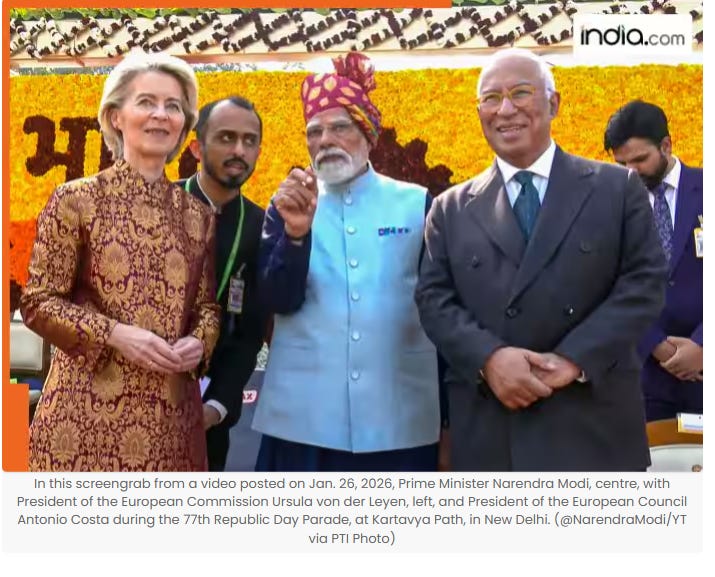
Just this week, for example, the Indian government renamed the state of Kerala as Keralam (the name of the state in the local language), as part of this program to decolonise Indian culture. Earlier this month, the Indian President Droupadi Murmu removed an old colonial statue of Edwin Lutyens, the architect of post-Mutiny New Delhi, at a state ballroom, Ashok Mandap at Rashtrapati Bhavan (itself renamed in 2024 to remove Anglicised traces). The statue was replaced with a bust of a freedom fighter and the first and only Indian governor general of independent India, C Rajagopalachari. Edwin Lutyens had also designed New Delhi’s grand ceremonial road – the Kingsway – to display British imperial might with architectural symbols of the Raj all along the path. This road is both symbol and and stage for cognitive decolonisation. Its name has been changed and its statues removed over the years. It is also the venue of the Republic Day Beating Retreat march. Since 2022, all vestiges of colonial statues and Western-composed music were removed from this ceremony. The grand parade no longer honours the expelled and disgraced Mountbatten-Windsors. It is called the Kartavya Path, the path of duty. At the 2026 Republic Day ceremony Narendra Modi’s guests of honour were not British, nor American. They were the German President of the European Union, Ursula von der Leyen, in a traditional Indian dress, and the President of the European Commission, Antonio Costa, former Prime Minister of Portugal, and proud owner of an Indian overseas passport.
The program of cognitive decolonisation extends to more practical concerns than statues for the pigeons and street parades. There has recently been a major discussion of the education system, in which Modi is pitched against Thomas Babington Macaulay. Macaulay was a British historian, poet and . . . no, not a bureaucrat, but . . . politician. Indeed, he was Secretary of War in the British imperial Cabinet between 1839 and 1841, that is, during the First Opium War. In 1835 Macaulay wrote a ‘Minute on Education’ that colonised the Indian mind, and co-opted its elites, through schools and the prioritisation of the English language. Modi’s program pushes for decolonisation of education and traditional knowledge systems, promotes the use of the Hindi term Bharat for India, and demotes the role of English as an aspirational language. There is a rich debate about whether this program is justified, whether it will have unintended impacts on social cohesion, economic opportunities and indigenous and constitutionally recognised languages other than Hindi. It makes some British liberal scholars of India, like historian William Dalrymple, squirm with discomfort at chauvinistic or authoritarian nationalism. But is dear old William becoming a new liberal coloniser of the Indian mind?
Some Indian liberals, however, perceive these acts of cognitive decolonisation as taking India too far down the Hindutva path, especially if they are exclusionary and particularly when they refer to periods of Muslim and Persian colonisation or conquest of Bharat. Many Western liberals, such as historians William Dalrymple and Audrey Truschke, agree with, and amplify, these concerns with ‘Hindu nationalism.’ Together, these commentators feel the latest phase of Indian decolonisation is a betrayal of the Nehruvian tradition of democratic, secular, and socialist (often forgotten in the West after 1991) values that promoted a “composite culture” that recognized India’s diversity. Strong advocates of real decolonisation, such as Shashi Tharoor, whose state of Kerala just received a “new consonant”, dismiss some of the acts as cheap electoral politics.
Decolonising the Mind: Maybe
But is it? The debate will rage on. In my interview with Salvatore Babones last year he criticised many of the critics of the BJP and the loose label of ‘Hindu nationalism.’ Many of Salvatore’s assessments of the exaggerated doom about the BJP destroying democracy are on the mark. On the other hand, I recently watched an interview with distinguished Indian historian of India, Romila Thapar, in which she eloquently explained how Modi’s India is following a different path of decolonisation that does not fulfil the expectations she had in 1947 when she was a 15-year old excited by independence.
What is remarkable about this interview is that you can hear not only the voice of an eminent historian (who we met on the Mahabharata slow read last year). This is a primary source testimony of the decolonising mind herself. Thapar describes her experiences in the year of independence, studying Gandhi’s speeches, and contacting Nehru himself. She says the point of independence and decolonisation was the experience of freedom in its plurality - in the self, culture, daily life, many communal identities - as much as an abstract, learned obedience to one nation.
Now nationalists in India today castigate Thapar for an ‘elite colonial mindset’ as much as she disdains their crass abuse of history. I am not pronouncing on that debate. On one hand, Thapar’s subtlety and scholarship appeal to me. But, then again, is she repeating Gandhi’s mistake of making satyagraha into a vision of a nation that is for the select few, and not the many.
The question it raises for me is: does the path of decolonisation actually end in the Nation?
Or does decolonisation, as an experience of freedom in plurality (thinking especially of Hannah Arendt’s use of the term), bypass the nation to begin and end in the individual mind?
It is a reminder of what the American-Punjabi historian, Priya Satia, described as the “complexity of the colonised mind.” After all, most minds in history, at least for the last five hundred years, have been colonised, more or less, sooner or later, now and then. The colonised mind was - and is, speaking for myself - complex because of:
“the way in which indigenous ways of being and modes of ethical practice were in dialectic struggle with other modes shaped by generations of colonial rule.”
Satia, Time’s Monster: History, Conscience and Britain’s Empire (2020), p. 217
The British colonialists made a case for a certain form of liberal nation to justify their rule; many Indians on left, right and centre embraced it. The nation became the path for modern development and, especially within India’s socialist traditions, a vehicle or an engineered machine for social emancipation. Yet the concept of nation was a Western idea; and perhaps the path from colony to independent nation was not the only way that post-colonial minds could follow.
Indeed, many post-colonial thinkers and leaders rejected the idea of the nation state. Nation and nationalism were ideas they were fleeing, as much as running towards, as outlined perhaps most eloquently in Rabindranath Tagore’s great lectures on nationalism, delivered in Japan, in 1917.
Tagore, Nehru, Césaire, Senghor and many others explored, in the Century of Decolonisation, both ideas and implemented models of polity that put the ‘nation’ in the dustbin of imperialist history. The USSR was one such experiment. Pan-Africanism another. So was the Socialist Republic of India. When decolonisation became nationalism, many anticolonial thinkers feared, it was barking with their master’s voice. Satia wrote:
Decolonisation narratives have taken a colonial form by presuming the nation-state as their exclusive horizon. But all over European colonies, anticolonial thinkers imagined other collective futures. If interwar communists and liberal imperialists were committed to international visions, so, too, were many anticolonialists. They tried to imagine and create alternative forms of community and tried to articulate other historical trajectories, distinct from what liberal empire had to offer.
Satia, Time’s Monster: History, Conscience and Britain’s Empire p. 218
Nationalist decolonisation and global counter-colonisation
I have written previously about Satia’s extraordinary book, Time’s Monster, and her essay on Nehru’s failure to stay true to a vision of India beyond the nation. She envisages a different kind of history writing faced with the catastrophes of modern international politics in a ‘world of nations.’

I have returned again to this theme this week in exploring the vast and complex topic of India’s and South Asia’s experience of decolonisation. There are so many aspects of that experience - not least India’s long-standing leadership role in decolonisation - that I have had to leave out many stories; but many were discussed in my world history tour of India and South Asia last year.
But it does strike me that cognitive decolonisation need not end in the nationalist assertion of a new civilization-state, which is, in other words, a 21st century revival of the nation-empires that fought the Last Imperial War, 1931-1945. There is a third way, or a gateless gate, of decolonisation that really does end in the mind.
In my Long Read this week I jotted down a thought as an aphorism.

We live the paradoxes of globalised colonisation and endure the strange defeats of nationalist decolonisation.
—Jeff Rich
Strange defeats of nationalist decolonisation
I have shared some of the strange defeats of nationalist decolonisation in this essay. Strange Defeat was the title of historian Marc Bloch’s analysis of the failure of the French elite mind in the defeat by Germany in 1940. Partition was surely a strange defeat of nationalist decolonisation, though caused as much by the the metropole as the periphery. There have been many others. Part of the tragedy of the United Nations is that a mere sovereign nation cannot escape the spider’s web of the USA’s neo-colonial empire.
For many leaders of Marco Rubio’s “anticolonial uprisings”, the nation-state was the best available vehicle for decolonisation. The post-colonial state promised to unify nations as an “imagined community”, in Benedict Anderson’s famous phrase. That project was not mere practical business, but carried a socio-cultural dream. The liberated third world would emancipate the oppressed. Sadly, it often dragooned many weak collective identities into one militantly enforced ideal community. Colonial social hierarchies were replaced by post-colonial successors. Knives were wielded by new masters. New displacements rekindled old resentments. There is a lot of blame to share around, and many bad memories to repress.
But one should not paint too bad a picture. India’s achievement of decolonisation is astounding. 75 years of state-building with no coup and one notorious Gandhian state of emergency. Close to half a billion people lifted out of poverty. Many cultures renewed and surviving. Democratic diversity under adversity, even the assaults of one "old, rich opinionated and dangerous” billionaire investor. That complex achievement is too often casually and cheaply overlooked by people, who really ought to know better and do about other great states in the world.
That achievement is especially astonishing when you consider the path decolonised India has walked. Britain’s famed rule of India with a handful of good old boy English aristocrats left the place a dreadful mess. Mountbatten and, later NATO chief, Lord Ismay’s negligent failures caused the suffering of millions in Partition. That wound would bleed again last year in Kashmir. When the British left India in 1947, India endured, as the gifts of benevolent British rule, a 16 per cent literacy rate, 90 % of the population below poverty line, the world’s highest maternal mortality rate, and an average life expectancy of 27 years. Today, India’s economy is larger than Britain’s. Indeed, it is the third largest economy in the world as measured by GDP PPP. By 2023, life expectancy had reached 72 years. In 75 years of freedom from the British empire, Indians had gained 45 more years of life, and become the most populous nation on this one earth.
Paradoxes of globalised counter-colonisation
The cultural influence of decolonised Indian minds has also grown, as I frequently comment and demonstrate on the Burning Archive. It is not just a question of minds, but of migration; and here let me say some final words on the paradoxes of globalised counter-colonisation.
I referred this week to ‘counter-colonization’ in my tribute to Felipe Fernández-Armesto.

“For decolonization has been followed by counter-colonization. The heartlands of Europe’s former world empires have been invaded by their erstwhile victims and the ecological consequences of the imperial age - the effects of migration and disease and of the rededication of soils - are being reversed or redirected.”
Fernández-Armesto, Millennium (1995), p. 524
Counter-colonisation is one provocative way to think about the enormous Indian and South Asian diaspora, and the utter reliance of Christian ‘Western civilization’ on the talents of these people. Knowing Felipe, he used the term - in 1993, mind you - to make a generous, empathetic observation, not a populist political complaint. He was not bewailing migration, because it will change the character of nations, as the Christian nationalists of Europe and MAGA and the civilizational imperialists of the USA do.
But in the thirty years since this observation, counter-colonisation has driven the politics of the Western world as much as decolonisation. Brexit, Trump, Euroskeptics, backlashes against migration, border control, refugee flows, population policies, fertility panics, street riots, arson attacks led by the vile Tommy Robinson of Little Britain, and even that absurd claim in the USA’s National Security Strategy 2025 that migration would soon lead the figure of Europe to disappear from the sands of history due to the forces of ‘civilizational erasure.’ There have even been protests against Indian migration on the streets of multicultural Melbourne; I am ashamed of this country for this outburst, but can only make sense of the reactions with these reflections on counter-colonisation.
Even Marco Rubio summoned this spectre of migration that is haunting Europe in his speech at Munich. To Rubio and the moral conquistadores of the New Western Century, counter-colonisation is a threat to be repelled by a new era of unapologetic Western New World Colonialism. He insists on keeping the civilizational sanctity of the blessed Western mind, free of the taint of those damned heathens from the colonies. He is both historically and morally wrong. Counter-colonisation is not a threat, but a reversal of the ever-changing flow of people, resources and ideas around the world, also known by historians, at least, as globalisation. In the nineteenth century, the waves of white migrants went to the Western colonies of the world, like the USA and the place that I call home. It coincided with the high point of a culture of nationalism. But that day is gone.
I embrace and welcome the counter-colonisation of the world. It has enriched my life. It has freed my mind from the recolonising garbage that pours out from North American studios. Instead, what flows into my decolonised mind is the civilizational, religious, ethnic, linguistic, political plurality of India, and the many other cultures of the world. I would welcome a new phase of political decolonisation to strengthen that current, to protect my mind, and to enlarge the world’s freedom from the Western Empire’s newly declared Reconquista.
India will play a leading role in that next phase of decolonisation, not just because of politics, but because of culture. As Rabindranath Tagore once wrote:
"India represents the wealth of mind which is for all. We acknowledge India’s obligation to offer to others the hospitality of her best culture, and India’s right to accept from others their best.”
—Rabindranath Tagore
Thanks for reading
❤️🙏🌎
Jeff
P.S. It has been a big week of other content for me, including
The Monthly Long Read: Decolonisation III: Africa is Back. Part Two
The Monthly Historians Tribute: Historians Who Made Me: Felipe Fernández-Armesto
My appearance on Pascal Lottaz Neutrality Studies, Collective West Just Declared War On The Global South | Dr. Jeff Rich
My interview with Cameron Gordon, Technocracy Took Over, But Will It Win? How the World Economy Has Changed Since 1800.
A 18 minute clip from my extended interview with Ulrike Guérot, Rubio Praises Colonialism and Europe's Captured Elites Applaud: Ulrike Guérot explains why
My video reflections on Evil and the Banality of Intellectuals concerning how the Epstein files exposed some famous intellectuals who were involved or covered up years of abuse. Do thoughtful intellectuals also suffer, in Hannah Arendt’s famous phrase, “the banality of evil”?
Time for a rest, maybe? My next Slow Read poem will be on Monday, and I will defer my Monthly History Book Club guide till Monday. And I can promise you there are some fantastic guest interviews coming next week. Thanks for your support and friendship.
Joya Chatterji, Shadows at Noon: The South Asian Twentieth Century (2024), p. 59.
Thought-provoking stuff! (& I now have Time's Monster on order as it sounds highly relevant to some notes I jotted down this week for a possible Midnight's-Children-tangent post on the idea of history in the Indian independence movement...)
Interesantísimo ensayo.